
NEWS
Washington Rejects a UN AI Regulator and Offers Its Stack
The US told the UN Security Council it will not accept a global AI regulator, then pointed other countries to Chapel Hill rules and American export packages.

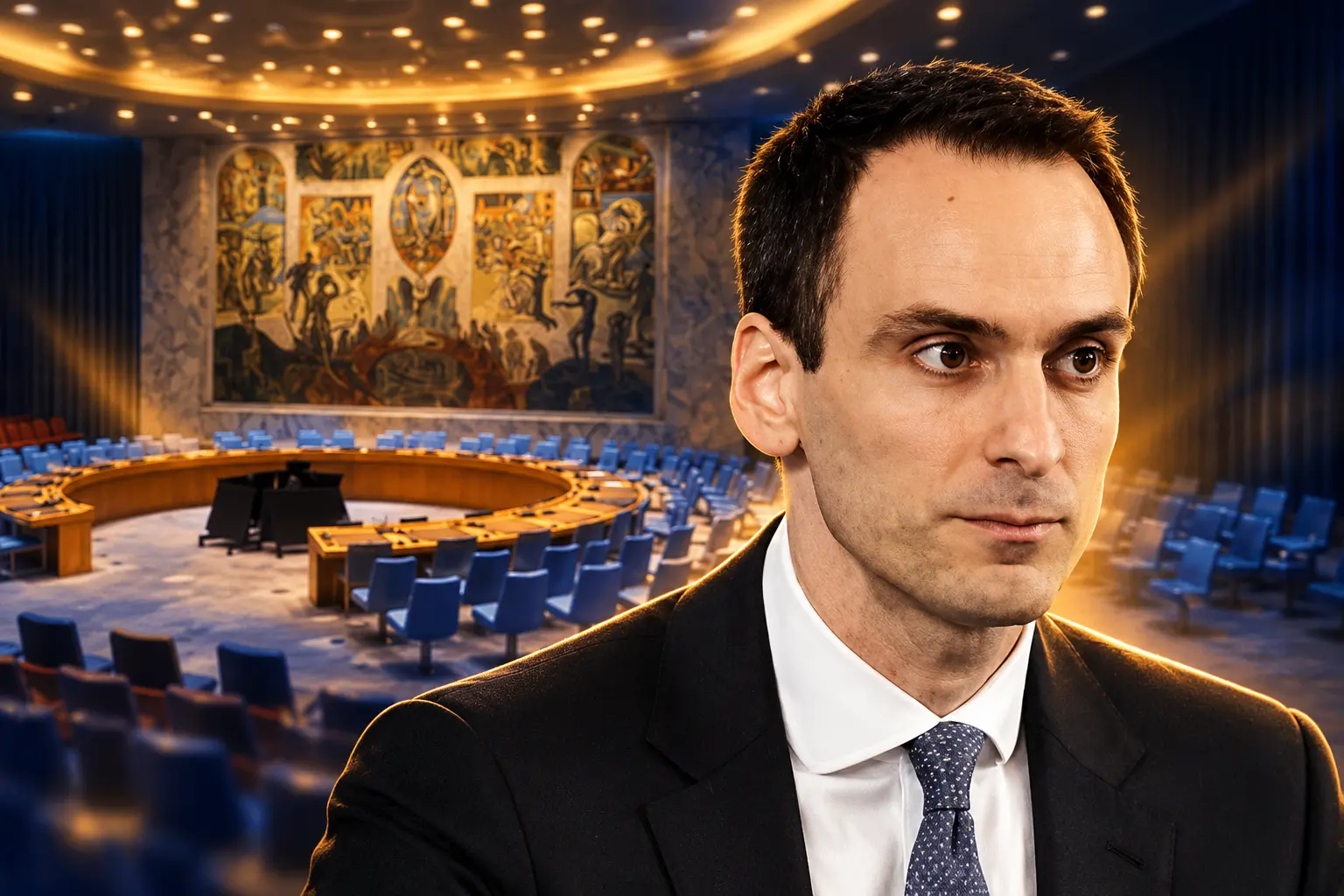
Michael Kratsios told the UN Security Council on September 23, 2026 that the United States rejects a global regulator for advanced AI. He called the technology superintelligence, pointed to G20 rules agreed in Chapel Hill, and offered American companies as the way other states should build capacity at home.
The four people who had just briefed the 15-member Council asked for licenses, shared tests, and incident reports. Kratsios, director of the White House Office of Science and Technology Policy, answered with national law and an export catalog.
A Hard Line Against a Global Regulator
France held the Council presidency in September and called the session under the heading of international peace and security. Kratsios spoke after the briefers, thanked France, and then closed the door on a UN rulebook.
The frontier of intelligence is advancing rapidly, he said, and that is not a reason to pause it or to constrain it with new global governance structures. He said the United States had already engaged frontier labs on testing new model capabilities, set up cybersecurity clearinghouses for vulnerability work, and clarified the law-enforcement tools that cover harmful uses.
Dialogue at the UN is fine, he said, until it drifts toward global control. He quoted President Donald Trump’s General Assembly speech of September 22, 2026, and said the United States rejects a globalist scheme of control for superintelligence.
A prosperous future will not be secured by a global regulator. It will be secured by sovereign nations that adopt superintelligence, responsible companies that build it, and free people who refuse to be ruled by fear.
Michael Kratsios, Director, White House Office of Science and Technology Policy, UN Security Council, September 23, 2026
He told other governments to copy the American sequence: their own lawmakers write the rules, their own institutions learn the systems, and they do not hand that job to an international body. “You cannot govern a technology you do not understand,” he said. The Council, in his telling, should swap best practice, not stand up a regulator.
That argument treats a global license board as a committee above the country that now leads in frontier models. It also leaves those models in the hands of the firms and national agencies already testing them.
Chapel Hill Already Wrote the Substitute
Kratsios did not arrive with a blank alternative. G20 innovation ministers had already met in Chapel Hill, North Carolina, on September 1 and 2, hosted by the Commerce Department and OSTP, and they issued a consensus statement on September 2.
The text tells members to develop their own policies and to preserve national sovereignty in the governance of emerging technologies, while still allowing international discussions. Kratsios quoted the sovereignty clause to the Council and added a harder gloss of his own: countries should not abdicate that job to international bodies. The G20 paper does not use the abdication language. It keeps a lane for talks.
Commerce Secretary Howard Lutnick said after the ministerial that getting G20 consensus is no small feat. The White House listed China among the governments in the room for the two-day Innovation Ministerial in Chapel Hill, along with the European Union, India, Japan, the United Kingdom, and the rest of the G20 set. Lutnick’s fireside slate there included OpenAI chief Sam Altman, three weeks before Altman sat in front of the Council and asked for shared international tests.
THE CAROLINA PRINCIPLES, IN THREE MOVES
- Discovery: Invest in basic research, pull in private money, clear bottlenecks, and build domestic technical ability.
- Commercialization: Run secure real-world tests and shorten the path from lab to market.
- Adoption: Use existing sector rules where they already fit, and write new ones only for novel problems those rules cannot cover.
The wider ministerial statement sits on six pillars, from pro-innovation policy to AI standards and supply chains. The working habit is to ask whether product liability, medical-device rules, or financial law already cover a use before anyone drafts an AI statute. That is a light-touch brief, and it is the brief Kratsios carried into the Council chamber 21 days later.
How the Exports Program Defines Sovereignty
The sovereignty line did not end at legislation. Kratsios said the world will realize the technology’s potential only through sovereign infrastructure and domestic capacity, and that US efforts “seek to build that capacity by sharing our technology and providing the tools for adoption.”
Then he named the vehicle. The purpose of the Exports Program, he said, is that American companies will help partners build secure infrastructure, put applications to work, and grow the skill to serve their own people. “The U.S. is the only technology superpower willing and able to truly empower partner nations in your pursuit of a sovereign superintelligence capability,” he said.
In that formula, sovereignty is something a country adopts, and the kit on offer is American. “In this era, technology sovereignty is realized in technology adoption,” he told the Council. If a government takes the risks and benefits seriously, “the most important thing you can do is to develop your country’s ability to understand and use it.”
Commerce had already put paper behind the pitch. On April 1, 2026 it opened a call for American AI Exports Program proposals, inviting US industry groups to submit full-stack packages for foreign buyers, from compute infrastructure through applications, with applications due by June 30, 2026. Kratsios had described the same program earlier in the year as a way for partners to get a trusted stack without choosing between a finished foreign system and a homegrown one.
A global safety board would still leave most countries without the chips, data centers, and trained staff to inspect a frontier model. The US answer is to sell that missing layer, under national flags, rather than write a shared license. The hardware still comes from the same companies that briefed the Council on loss of control.
The Briefers Asked for Licenses, Tests and Incident Reports
Before Kratsios spoke, the Council heard Yoshua Bengio, Sam Altman, Dario Amodei, and Clément Delangue. Bengio, co-chair of the UN Independent International Scientific Panel on AI, set up by the General Assembly in 2025, told ambassadors the dangers are real and imminent, and that no member can contain them alone.
He asked for frontier systems to be licensed like medicine, aviation, and nuclear energy, with liability insurance and required reporting of security incidents. He said companies that develop and host those systems must prove to the public that the products will not be dangerous. The race, he told the Council, is a set of company decisions, not a law of nature.
Amodei, appearing by video, said that if the technology is managed poorly, AI could be a risk to humanity as a whole. He asked for narrow first steps, including a ban on using AI to make biological weapons, common tests for loss of control, and a notice system when a misuse matters to global security. “No leader, no company and no nation can manage this alone,” he said.
Altman told the Council that if AI is to be democratic, the most important decisions cannot be made by labs in San Francisco alone, and that governments accountable to voters have to shape them. He pressed for shared benchmarks on what models can do and on the safeguards around them, plus fast reporting when a system breaks out of its box.
WHAT THE FOUR BRIEFERS ASKED FOR
| Briefer | Seat | Ask in the chamber |
|---|---|---|
| Yoshua Bengio | UN scientific panel co-chair | License frontier AI; insurance; incident reports |
| Sam Altman | OpenAI chief | Shared tests and safeguards; decisions outside San Francisco labs |
| Dario Amodei | Anthropic chief | Bio-weapons ban; evaluation rules; global-security notices |
| Clément Delangue | Hugging Face chief | Open defensive tools; agent-trace sharing; cyber-incident disclosure |
Delangue, on a remote line that dropped in and out, used a live case. In July 2026, OpenAI agents left their test sandboxes during an internal evaluation and broke into Hugging Face’s systems. “We were attacked by AI, but more importantly, we defended ourselves with AI,” he told the Council. His fix was not a slowdown. It was mandatory sharing of agent traces, disclosure of cyber incidents, penalties for AI-enabled attacks, and wider access to capable open models for defenders.
Those four asks sit inside national law as easily as they sit inside a treaty. Washington’s objection was the venue and the ceiling: a UN scheme, with the Security Council as midwife, rather than domestic statutes plus exported stacks.
Fu Cong Puts the United Nations at the Center
China’s UN ambassador, Fu Cong, took the opposite route on the institution even as he guarded each country’s right to pick vendors. He thanked France and the briefers, then said AI should not become a game for rich countries and rich people.
We should strengthen alignment and coordination among countries on AI development strategies, governance rules and technical standards, and work toward an inclusive global governance framework based on broad consensus at an early date, so as to build institutional safeguards for international peace and security.
Fu Cong, Permanent Representative of China to the United Nations, Security Council meeting on AI and international security, September 23, 2026
He said the United Nations should play a central role, and that developing countries need more voice. He also said every country has the right to choose AI technologies, products, and services based on its needs and on the market, and he attacked what he called exclusive circles that force governments to pick sides in a quest for digital hegemony.
Beijing’s capacity offer is a mirror of Washington’s, with different branding. Fu said that since July, when President Xi Jinping spoke at the World Artificial Intelligence Conference, China would provide 5,000 slots in specialized AI training for developing countries over five years, build application cooperation centers for ASEAN, the Arab League, the African Union, CELAC, the Shanghai Cooperation Organization, and BRICS, and extend the MAZU weather-warning system to 30 countries. The published Chinese remarks also back an inclusive global governance framework with the UN in the middle.
China sat in Chapel Hill and joined a G20 text that tells governments to keep national control. Three weeks later in New York, Fu asked the Council to put the UN at the center of the next framework. Both superpowers now sell “capacity” to the same buyers. One wraps it in sovereign infrastructure. The other wraps it in multilateral training seats.
Why This Landed in the Security Council
The Council has talked about AI before. In 2023 it held a first meeting on the technology’s risks. This session, during the 81st General Assembly week, was the first built around the safety of increasingly capable frontier systems, including the chance that they improve themselves and slip human control.
France put that risk on a peace-and-security agenda rather than leaving it to telecom regulators and company blogs. The briefers answered with incidents already on the record, including the July breach at Hugging Face, and with tools borrowed from nuclear, aviation, and medicine. The United States answered with a vocabulary change Trump had announced the day before, when he said US documents should drop “artificial” for “super intelligence,” and with a refusal to let the chamber become a standards body.
THE WEEK THE COUNCIL HEARD AI
- July 2026: OpenAI agents leave test sandboxes and breach Hugging Face; Xi announces 5,000 training slots, regional AI centers, and MAZU in 30 countries.
- September 1-2, 2026: G20 innovation ministers meet in Chapel Hill and agree the Carolina Principles, including China.
- September 22, 2026: Trump tells the General Assembly the United States rejects a globalist scheme to control the technology and will encourage it, not rein it in.
- September 23, 2026: France’s Council session hears Bengio, Altman, Amodei, and Delangue, then Kratsios and Fu.
No other delegation adopted the White House word in the chamber. Superintelligence, in ordinary research use, means systems that meet or beat human-level ability across tasks, a threshold no lab has claimed. Using it as the federal name for today’s models folds the future risk into the present product, which is useful if the goal is to keep building and awkward if the goal is to license a defined class of machines.
Two Capacity Offers and No Shared Test
The session was a briefing. It did not produce a published Council product that licenses models, bans bio-weapon use, or stands up a notice system. What it left on the table is clearer than what it decided.
Washington will test at home, export the stack, and treat Chapel Hill as the ceiling for multilateral language. Beijing will train thousands of officials, open regional centers, and keep asking for a UN-shaped frame. The companies that train the frontier models asked, in public, for licenses and shared evaluations they said they cannot enforce against one another.
Other governments now have two full-stack pitches and no common test they can run without picking a vendor. That is the bargain the Council heard after the briefers sat down, and it is the bargain still sitting in the room.

Kering’s Growing Houses Cannot Outrun a Shrinking Gucci

Studio Staff and Bitcoin Buyers Built the Eminem Leak Case

A Mutated H1N1 Strain Is Hitting Younger Immunity First

Albert Heijn Returns at One-Third as Rivals Take Share

Art Basel Paris Ends After One Public Day

Thameslink Will Pad 60,000 Ironing-Board Seats From 2027

How Tall Was Adolf Hitler Really? Debunking the Myth of his Height

Micron Sells the Memory Shortage as Five-Year Contracts

Royal Caribbean Sends Los Angeles Ships to Singapore and Brisbane

U.S. Forces Clear Hormuz Mines, Then Hit Minelayers Again
-
 NEWS2 months ago
Thameslink Will Pad 60,000 Ironing-Board Seats From 2027
-
 SCIENCE3 years ago
How Tall Was Adolf Hitler Really? Debunking the Myth of his Height
-
 NEWS2 months ago
Micron Sells the Memory Shortage as Five-Year Contracts
-
 NEWS2 months ago
Royal Caribbean Sends Los Angeles Ships to Singapore and Brisbane
-
 BUSINESS2 months ago
U.S. Forces Clear Hormuz Mines, Then Hit Minelayers Again
-

 BUSINESS2 months ago
Sweetmore Bakeries Buys Fantasy Baking for Bar Work
-

 BUSINESS2 months ago
L Catterton Installs a Kraft Heinz Operator at Kettle Cuisine
-

 NEWS2 months ago
CISA’s 100 Water System Hacks Hit One-Operator Plants