
NEWS
Samsung’s Record Profit Puts a Memory Tax on Galaxy
Samsung guided to 107.40 trillion won in Q3 profit as AI memory soared, while Galaxy S26 prices and PC bills absorb the same shortage through 2027.

Samsung Electronics guided to about 107.40 trillion won ($80.17 billion) in third-quarter operating profit, up 782.5 percent from a year earlier. The October 8 figure is the median of a tight range, and it is the first time a technology company has cleared 100 trillion won in a quarter.
Sales are seen at about 195 trillion won, 126.6 percent above the 86.06 trillion won posted a year earlier. The shortage behind those numbers is already on the Galaxy S26 price list, and on the parts bill of phones and PCs that still run on ordinary memory.
Samsung Posts 107.40 Trillion Won and Leaves the Split for Later
In its approximately 107.40 trillion Korean won operating-profit guide, Samsung also put sales at about 195 trillion won. Korean rules bar a range in the headline, so both numbers are medians: sales 194 trillion to 196 trillion won, profit 107.3 trillion to 107.5 trillion won, under K-IFRS. Net profit was not included.
The print beat an LSEG SmartEstimate of 106.1 trillion won. It is Samsung’s fourth straight record quarter, a run that started in the last three months of 2025. Nvidia’s operating profit for the quarter ended in July was $63.7 billion. The only larger quarterly operating profit on recent record is Saudi Aramco’s $86.5 billion in the second quarter of 2022, after oil jumped.
SAMSUNG’S GUIDED PRINT AGAINST THE PRIOR TWO QUARTERS
| Period | Sales (trillion won) | Operating profit (trillion won) |
|---|---|---|
| Q3 2025 | 86.06 | 12.17 |
| Q2 2026 | 171.5 | 89.49 |
| Q3 2026 guidance | about 195 | about 107.40 |
Against the second quarter, profit is up 20.0 percent and sales are up from 171.5 trillion won. Against the year-ago quarter, profit is 8.83 times the old level. The implied operating margin on 195 trillion won of sales is 55.1 percent, a factory figure almost no other manufacturer prints.
A FactSet-compiled consensus had sales at 206.810 trillion won, so the top line is light next to the profit surprise. That gap is the tell. Volume is not what moved the quarter. Price is.
Meritz Securities estimates Samsung’s DRAM shipments rose 3.4 percent from the second quarter while average selling prices jumped 20.1 percent, with NAND shipments up 4.2 percent and prices up 19 percent. Douglas Kim of Douglas Research Advisory put Samsung’s HBM shipments up close to 50 percent from the prior quarter. Analysts have put the chip unit near 110 trillion won, above the company total, which is how phones, appliances, and foundry land in the red on paper. Samsung will not confirm any of that split until October 29.
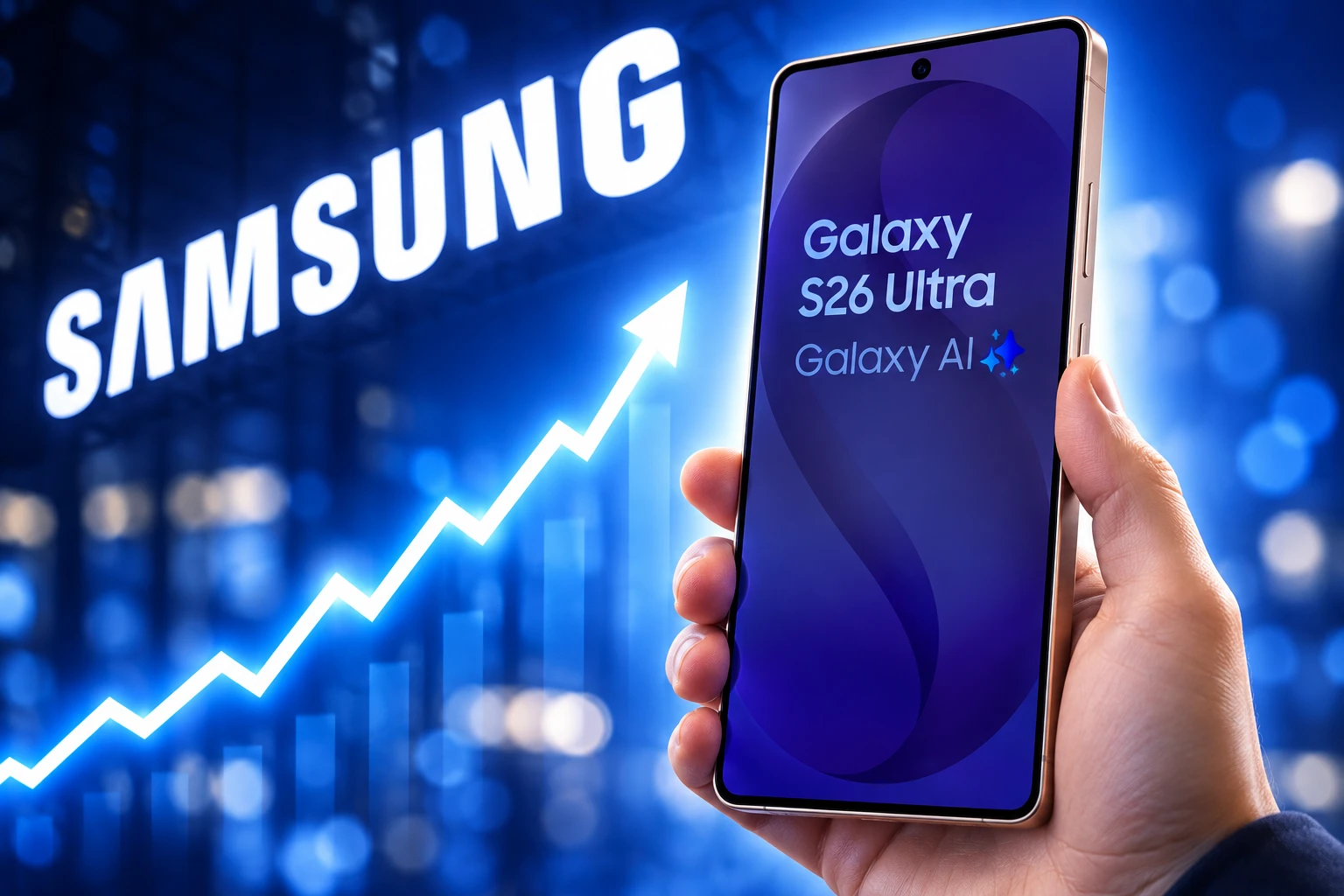
Galaxy S26 Prices Jumped $100 Seven Months After Launch
On October 1, seven months after the Galaxy S26 went on sale in March, Samsung raised US list prices on the S26, S26+, and S26 Ultra by $100, and by $200 on the 1TB Ultra. The Fan Edition and the new Z Fold 8, Z Fold 8 Ultra, and Z Flip 8 were left alone. Samsung put out no statement with the new tags.
GALAXY S26 U.S. LIST PRICES FROM OCTOBER 1
- Galaxy S26 256GB: $999.99, up $100 from $899.99.
- Galaxy S26+ 256GB: $1,199.99, up $100 from $1,099.99.
- Galaxy S26 Ultra 256GB: $1,399.99, up $100 from $1,299.99.
- Galaxy S26 Ultra 1TB: $1,999.99, up $200 from $1,799.99.
In South Korea the 256GB and 512GB models rose 149,600 won. The 256GB S26 went from 1,254,000 won to 1,403,600 won, and the 1TB Ultra rose 276,100 won to 2,821,500 won. Apple and Google have each added about $100 to their latest phones, so swapping brands does not dodge the bill.
In July, when co-CEO Roh Tae-moon unveiled the new foldables in London, he told reporters the company would hold the line on shoppers.
We will not pass the full (cost) increase on to consumers.
Roh Tae-moon, Samsung Electronics co-CEO, London, July 2026
Two weeks later the Z8 series took a record 1.44 million preorders in Korea. By October the seven-month-old S26 was more expensive anyway. Roh never promised a freeze. He also never priced a world in which memory, not cameras or screens, would set the tag.
Memory Now Takes 43 Percent of a Premium Phone’s Parts Cost
Samsung has not released a mobile result for the third quarter. Brokerages put the mobile and networks businesses at an operating loss of 900 billion won to 1.9 trillion won. That follows a 700 billion won operating loss in the second quarter, the first quarterly loss that unit has posted.
The hole is not empty stores. Daishin Securities estimates third-quarter smartphone shipments were little changed from a year earlier, with average selling prices up nearly 3 percent. Handset prices did not keep up with parts. Eugene Investment & Securities analyst Son In-jun said Samsung had chased share by limiting price increases, and that holding the line would deepen the third-quarter loss even if the new foldables sold well.
Counterpoint Research’s second-quarter figures show why the squeeze hits Samsung harder than Apple. Samsung held 23 percent of global smartphone shipments and 16 percent of revenue. Apple held 21 percent of shipments and 49 percent of revenue. Kim Rok-ho, a semiconductor analyst at Hana Securities, said a mix built on low- and mid-priced models cannot carry this memory bill without the profit going first.
The cost has moved into flagships too. Counterpoint estimates memory’s share of a representative premium smartphone’s parts cost reached 43 percent in the third quarter, up from 14 percent a year earlier. Those are industry figures, not Samsung’s factory invoices. Counterpoint Director Tarun Pathak said buyers were already delaying upgrades, waiting on big sales, or shifting to the used market as prices climbed.
Making the chips in-house does not close the gap. Kim said offering Galaxy a discount would mean forgoing higher-priced sales to outside customers, and that making memory and getting it cheap are different jobs. A Samsung representative said Galaxy buys memory from several makers and called the rise an industry problem. Full results will show whether that mix changed anything.
HBM Is on Track for Nearly 30 Percent of DRAM Wafers
The tax starts on the wafer, not the shelf. High-bandwidth memory, the stacked DRAM that sits next to AI processors, uses the same advanced lines as the chips in phones and PCs, and it uses more of each wafer for fewer bits. Samsung Electronics executive vice president Kim Taewoo said HBM is expected to take nearly 30 percent of the DRAM industry’s wafer capacity next year, up from about 20 percent now, and that more HBM means less conventional DRAM.
That crowding-out is why a boom in AI servers shows up as a $100 Galaxy tag. TrendForce says suppliers are still steering advanced capacity to high-performance server parts in the fourth quarter, and that PC DRAM supply could shrink in 2027 as more of the line moves to servers. Mobile DRAM stays tight because the higher-margin work is elsewhere. Graphics DRAM is on the same path: GDDR7 is being pulled toward AI chips, and some PC brands are looking back at GDDR6 to cut the bill of materials.
HBM itself has further to rise. Because it is priced on annual contracts, it did not fully track the 2026 spike in commodity DRAM. TrendForce has raised its 2027 outlook and now projects a 121 percent jump in blended HBM prices year over year, citing tight supply, a richer mix of HBM4, and HBM4e ramping in the second half of 2027. Some GPU and ASIC makers are weighing 8-hi stacks instead of 12-hi to stretch scarce supply, even though TrendForce expects 8-hi to carry a 10 to 20 percent premium per gigabit.
Cloud buyers are already living with that mix. TrendForce estimates DRAM and NAND together will take 47 percent of major cloud firms’ capital spending in 2026 and 68 percent in 2027, after server DRAM prices rose a cumulative 64 percent in the second half of 2025 and were seen jumping about 270 percent in 2026. Memory has become a line item that can move a data-center budget on its own.
A $900 Notebook Already Spends 68 Percent on Chips
The same day Samsung put out the 107.40 trillion won guide, TrendForce said the notebook risk for 2027 is no longer getting parts. It is whether shoppers will pay for them. Global notebook shipments are seen down by a low-single-digit percentage in 2027. If DRAM and CPU prices stay high and brands pass more of the cost through, replacement cycles stretch and the drop can move into high-single digits.
On a mainstream notebook with a $900 list price, CPU, DRAM, and SSD already make up 68 percent of the bill of materials in the third quarter. Brands then face three bad options: raise the sticker and lose demand, eat the cost and lose margin, or ship less memory and a weaker spec. TrendForce does not expect them to keep price, spec, and profit at once next year.
PC buyers are still placing orders because they expect 2027 to be tighter, which holds contract prices up even as finished-goods stock from the first half covers some fourth-quarter shipments. Client SSD buyers are cutting capacities in mainstream models. TVs, set-top boxes, and wearables have even less room. The consumer end of NAND is trying to buy as little as it can while still keeping a supplier relationship.
Why Contract Prices Rise More Slowly From Here
Fourth-quarter contract prices are still going up. They are not going up at the spring pace. TrendForce projects conventional DRAM up 10 to 15 percent quarter on quarter and NAND Flash up 15 to 20 percent, with enterprise SSDs the one group where the rise is seen getting faster, on cloud demand for AI inference and agentic workloads. Server DRAM stays short. Long-term agreements mean some suppliers will trail the spot average.
TRENDFORCE’S NEXT LEG OF MEMORY PRICES
| Product | Price path | When |
|---|---|---|
| Conventional DRAM | up 10 to 15 percent quarter on quarter | Q4 2026 |
| NAND Flash | up 15 to 20 percent quarter on quarter | Q4 2026 |
| HBM blended average selling price | up 121 percent year on year | 2027 |
A slower climb is not the same as a peak. It is what happens when more of the output sits under deals that already have a ceiling. Those deals are how suppliers are turning a hot tape into a multi-year rent. Micron has been five-year contracts for scarce chips to large customers, and the rest of the industry has been pushing buyers toward the same calendar. TrendForce still sees memory supply tight through 2027 as HBM and plain DRAM fight for the same advanced wafers.
That is why a record quarter can still feel like old news in the stock. The 107.40 trillion won confirms that AI data centers have been paying up. It does not settle how much conventional DRAM can still rise once those contracts cap the next move, or how far phone and PC demand cracks when the cheap inventory is gone. The print is a lagging receipt. The live argument is the duration of the tax.
October 29 Will Put a Number on the Phone Loss
Samsung publishes the full third-quarter results, with the split by division, on October 29. Until then the company-level guide is the only official profit number, and every mobile figure in the market is a brokerage guess.
WHAT WE KNOW
- The guide: Sales about 195 trillion won and operating profit about 107.40 trillion won, medians of the disclosed ranges, dated October 8.
- The shelf: Galaxy S26 US list prices rose $100 on October 1, and $200 on the 1TB Ultra, seven months after launch.
- The path: TrendForce still has DRAM, NAND, and HBM prices rising, with HBM’s 2027 blended average selling price up 121 percent.
WHAT IS UNCONFIRMED
- The chip take: Estimates near 110 trillion won for the semiconductor unit are not Samsung’s number.
- The phone loss: The 900 billion to 1.9 trillion won range for mobile and networks is a brokerage span, not a filing.
- The 2027 mix: Kim Taewoo’s near-30-percent HBM wafer share is a company view of next year’s capacity, not a booked split.
Meritz Securities sees the mobile and networks businesses swinging to about 1 trillion won of operating profit in the first quarter of 2027 on the next flagship, then slipping back to losses of 600 billion to 900 billion won in each of the next three quarters. Counterpoint senior analyst Shenghao Bai has warned that flagship gross margins can still sit below 2025 models even after the sticker moves. Kim Rok-ho’s test is not whether Galaxy can print a profit with the S27 in a launch quarter. It is whether the unit is still making money in the second and third quarters, after the new-phone rush fades.
On October 29 the filing will show how much of 107.40 trillion won was memory price, and how much of the other side of the house was paying it. The Galaxy S26 tag already gave the consumer version of that split, $100 at a time.

Kering’s Growing Houses Cannot Outrun a Shrinking Gucci

Studio Staff and Bitcoin Buyers Built the Eminem Leak Case

A Mutated H1N1 Strain Is Hitting Younger Immunity First

Albert Heijn Returns at One-Third as Rivals Take Share

Art Basel Paris Ends After One Public Day

Thameslink Will Pad 60,000 Ironing-Board Seats From 2027

How Tall Was Adolf Hitler Really? Debunking the Myth of his Height

Micron Sells the Memory Shortage as Five-Year Contracts

Royal Caribbean Sends Los Angeles Ships to Singapore and Brisbane

U.S. Forces Clear Hormuz Mines, Then Hit Minelayers Again
-
 NEWS2 months ago
Thameslink Will Pad 60,000 Ironing-Board Seats From 2027
-
 SCIENCE3 years ago
How Tall Was Adolf Hitler Really? Debunking the Myth of his Height
-
 NEWS2 months ago
Micron Sells the Memory Shortage as Five-Year Contracts
-
 NEWS2 months ago
Royal Caribbean Sends Los Angeles Ships to Singapore and Brisbane
-
 BUSINESS2 months ago
U.S. Forces Clear Hormuz Mines, Then Hit Minelayers Again
-

 BUSINESS2 months ago
Sweetmore Bakeries Buys Fantasy Baking for Bar Work
-

 BUSINESS2 months ago
L Catterton Installs a Kraft Heinz Operator at Kettle Cuisine
-

 NEWS2 months ago
CISA’s 100 Water System Hacks Hit One-Operator Plants