
BUSINESS
SpaceX Hunts 80,000 Towers and Pays the Landlords First
SpaceX is seeking 80,000 U.S. cell sites for Starlink Mobile, a tower-lease plan that pays landlords first while the big three wait on an unsigned deal.

SpaceX is negotiating for at least 80,000 U.S. cell sites as it tries to turn Starlink Mobile into a national carrier. People familiar with the talks say Crown Castle is in the mix and that no lease is signed. In extended trading on Oct. 22, Crown Castle jumped as much as 10%, while AT&T, Verizon and T-Mobile fell between 4.2% and 5%.
A satellite network sold as a way around towers is now shopping for about half the purpose-built towers in the country. The first check, if those talks close, goes to the landlords.
SpaceX Wants About Half of America’s Towers
People close to the discussions say SpaceX wants a floor of 80,000 sites, not a pilot cluster, and that it has been talking with at least one major infrastructure company to get there. Crown Castle is named in those talks. American Tower and Vertical Bridge sit in the same landlord tier. American Tower declined to comment. SpaceX and Vertical Bridge did not respond.
On Crown Castle’s Oct. 21 earnings call, an analyst asked CEO Chris Hillabrant whether the company was discussing leases with SpaceX, Amazon, or other satellite-based providers. Hillabrant would not name a customer. “You can assume that we’re talking to all parties,” he said.
Mobile networks put radios on steel, rooftops, and poles because that is how a phone call survives inside a grocery store. Carriers lease that space because sharing a tower is cheaper than owning every mast. SpaceX has spent the past year buying airwaves and launch rights. Site access is the piece that still sits on someone else’s land.
The Wireless Infrastructure Association counted 158,500 purpose-built cellular towers in the United States at the end of 2025. Eighty thousand sites is about half that stock. TD Cowen, a research firm, has put a full nationwide terrestrial build at more than $80 billion, spread over many years, with more spending after the headline number. The value of SpaceX’s tower deals, if they are struck, “could reach into the billions,” people involved in the reporting of the talks have said. That is not a signed master lease, a site count, or a term of years.
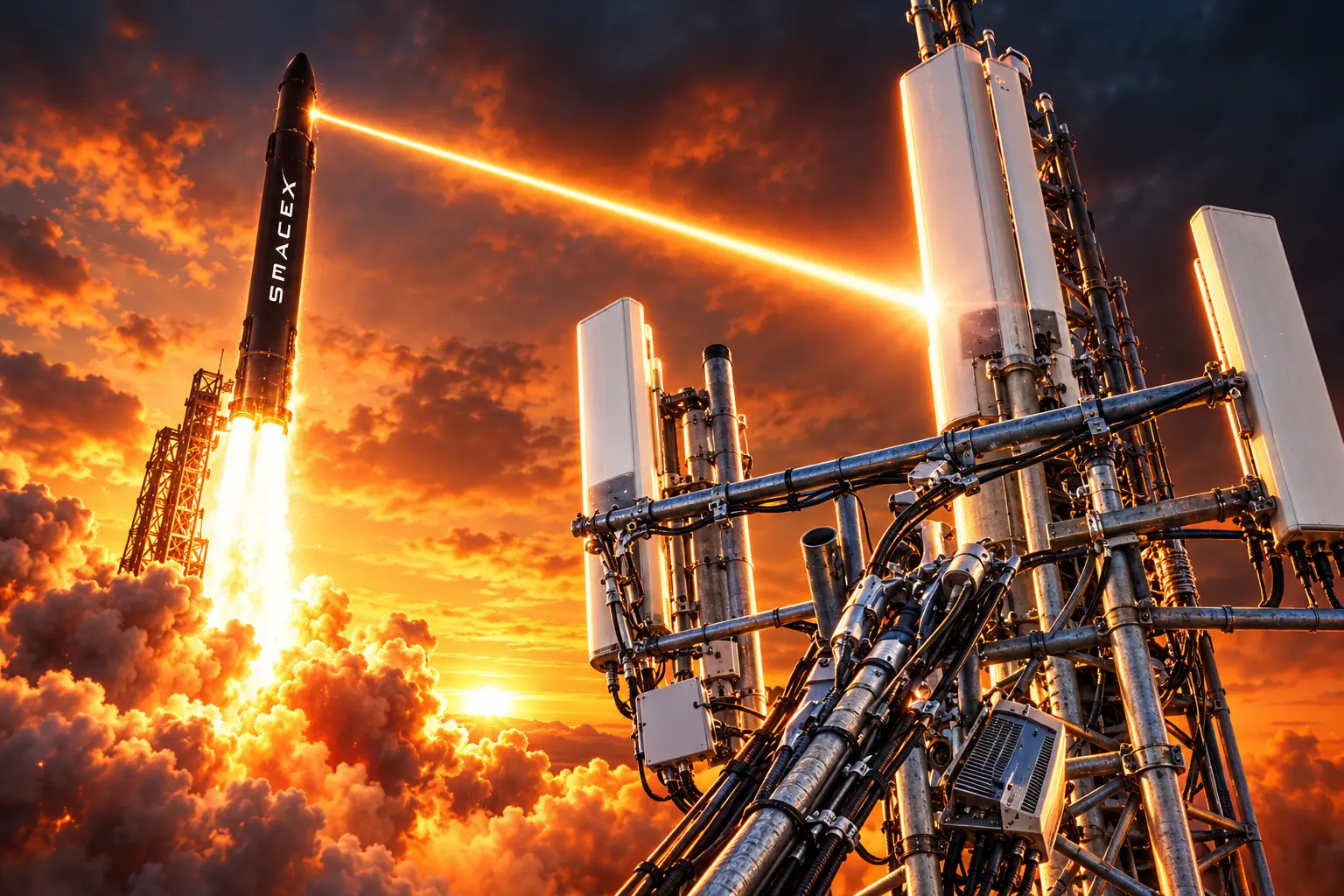
Why Starlink Mobile Still Needs Steel on the Ground
Low Earth orbit covers empty highway and ocean. It does not punch through parking garages, elevator shafts, or the core of an office block the way 800 MHz on a nearby mast does. Walter Piecyk, a partner at LightShed Partners, put the constraint in one line: “If I’m going to offer mobile service, I need some form of a terrestrial network.”
Sunit Patel, Crown Castle’s finance chief, told analysts the same thing from the landlord side of the table. “800MHz does solve one of the critical challenges for an eventual SpaceX deployment, which is you need low band to get into buildings,” he said. Breadth of coverage, he added, is what that band is for.
SpaceX has been stacking licenses and spacecraft around that gap. On Oct. 8 it agreed to buy Grain Management’s nationwide 800 MHz portfolio, up to 14 megahertz of paired low-band spectrum that Grain had taken from T-Mobile in August in a swap that included $2.9 billion in cash and Grain’s 600 MHz licenses. SpaceX did not disclose its price. People familiar with that purchase have put it near $8 billion. The deal still needs Federal Communications Commission approval.
That low-band layer sits on top of mid-band SpaceX is already buying from EchoStar: 65 megahertz nationwide for about $17 billion, cleared by the FCC in May 2026, with the second step of the transfer expected around Nov. 30, 2027. Until that step closes, SpaceX can test on the EchoStar frequencies with EchoStar’s permission. It cannot run a full commercial service on them.
THE SPECTRUM AND SATELLITE STACK
- Low band: Grain’s 800 MHz licenses, up to 14 MHz paired, pending FCC approval, aimed at indoor coverage on ordinary phones that already speak the band.
- Mid band: EchoStar’s 65 MHz, about $17 billion, FCC-cleared in May 2026, with commercial use gated on the November 2027 close.
- Orbit: FCC authorization for 15,000 direct-to-device satellites on Oct. 6, 2026, in nine shells between 326 and 335 kilometres, separate from the Starlink broadband fleet.
- What is flying now: SpaceX’s roadshow listed about 650 V1 mobile satellites in orbit as of March 31, 2026, with V2 deployment slated to begin in 2027.
In its Grain announcement, SpaceX said the 800 MHz licenses fill “one of the key remaining technical gaps” and that, with the next satellites, Starlink Mobile can “become the first network operator to deploy both satellite and terrestrial spectrum.” Elon Musk, SpaceX’s chief executive, called the purchase the last critical piece of the spectrum puzzle for complete phone coverage in America.
This is the last critical piece of the spectrum puzzle needed for SpaceX to provide complete phone coverage in America https://t.co/kKjP072xZf
— Elon Musk (@elonmusk) October 8, 2026
On this month’s earnings call he told investors the company will “be building out our terrestrial networks so there’s broad-based connectivity anywhere that SpaceX and Starlink are allowed to operate.” Gwynne Shotwell, SpaceX’s president and chief operating officer, has said the next-generation satellites plus the EchoStar spectrum look “100 times better than what we’ve got right now,” with the new birds due to start flying next year and service targeted by the end of 2027. The current U.S. phone product still rides a partner path with T-Mobile. A standalone carrier is a different animal, and it needs masts.
The 12,000 DISH Sites Still on the Steel
Hillabrant spent a long stretch of the Oct. 21 call on a shortcut that already exists on his towers. DISH built a 5G network, then stopped. Crown Castle still has that gear on more than 12,000 sites, he said, with room in the old plan to go as high as 20,000. Patel noted that DISH’s run took something like four years, and that some of the work is already up, so a new tenant could move on a tighter clock if it wanted speed.
This is the industry cheat code that exists in that DISH just built this network.
Chris Hillabrant, CEO, Crown Castle Q3 2026 earnings call
He said he knows the people who built it, many of them former T-Mobile colleagues, and that Crown staffed up on the services side to help them. Maximizing co-locations on towers that have already cleared zoning, he argued, beats dropping microcells that each need land, power, and backhaul. Asked whether SpaceX had actually called, he again refused a name. “We won’t discuss individual customer discussions and you can assume that we’re talking to all of them,” he said.
That is a landlord’s offer, not a network design. SpaceX has not said it will take the DISH overlay, reuse those radios, or start from a clean application stack. Hillabrant told analysts they will have to wait to hear from SpaceX. He also said Crown is ready. For a company that just booked $61 million of DISH terminations in the third quarter, a new national tenant is not a press-release curiosity. It is replacement rent.
The Rent Check Goes to Tower Owners
No single U.S. landlord holds 80,000 towers. Crown Castle told investors it has about 40,000 sites. American Tower has about 42,000 U.S. sites. Privately held Vertical Bridge has about 18,000. Add the three books and you get about 100,000. Crown Castle plus American Tower alone get to about 82,000, which is enough on paper if every site were usable, in the right place, and open to a new carrier. They will not all be. SpaceX has to stitch portfolios, and it has to do it without a public MLA.
WHO HOLDS THE STEEL SPACEX WANTS
| Holder | U.S. sites | In the Oct. 22 talks |
|---|---|---|
| SpaceX ask | At least 80,000 | People familiar; nothing signed |
| Crown Castle | About 40,000 | CEO says talks with all parties |
| American Tower | About 42,000 | Declined to comment |
| Vertical Bridge | About 18,000 | No comment |
| WIA tower base, end of 2025 | 158,500 purpose-built | About half would be 80,000 |
Hillabrant sketched two ways a SpaceX build helps him even if the tenant mix gets messy. SpaceX can lease directly. The big three can also spend more to defend indoor coverage once a new radio shows up on the same steel. Crown Castle’s annualized third-quarter rental split already runs 42% T-Mobile, 28% AT&T, 23% Verizon, and 7% everyone else. A fourth national brand would be a new column in that mix. It would also be a reason the first three might add gear rather than wait.
Matthew Niknam at Truist Securities called the report another catalyst for a towers group that the market has not loved. That is the tape logic in one sentence. Extra tenancy on a mast is high-margin because the steel, the power drop, and the ground lease are already there. Carriers, by contrast, are being marked as if a well-funded rival is about to price against them on the same map.
A rocket without a lease does not do that. A rocket that wants 80,000 leases does. The scariest object in this story, for a phone company, is not a Falcon. It is a Falcon that has learned how to file a tower application.
80,000 Sites Still Fall Short When Loaded
Sam McHugh, an analyst at BNP Paribas, ran the 80,000 figure against the networks that already exist. He put it at the upper end of carrier tower counts and noted that T-Mobile has about 85,000 towers plus about 60,000 small cells. If SpaceX built out to 80,000 sites with the spectrum it holds now, he wrote, the service would be somewhat comparable to the incumbents while the network had no customers on it. It would not match those networks once millions of subscribers were loading the cells.
That is a quiet demolition of the cheap-coverage pitch. A satellite overlay can fill rural holes and the far side of a ridge. It does not, on McHugh’s math, let SpaceX skip the dense grid and still claim a structural cost edge once the network is busy. He also argued that copying towers, spectrum, and stores from scratch looks like a poor payback, and that the more useful prize along the way would be an MVNO or roaming deal that lets Starlink Mobile sell service before the last site is on air.
He does not think a carrier will volunteer that deal. Without it, SpaceX has to build a lot of network before it has a product people will switch to, which crushes returns. Laurent Yoon at Bernstein made a narrower point about the 80,000 number itself: whether SpaceX leases anything close to that figure remains uncertain, but the reported scope “suggests a far greater level of commitment than spectrum accumulation alone.” McHugh floated a harder option. Talking the sector down, he wrote, also cheapens an acquisition, with T-Mobile the most credible target, and SpaceX has already shown it will buy when buying is faster.
SpaceX’s finance chief called the telcos a cartel at a public investor conference in September. That line sits in the same file as the unsigned leases. Pressure is a strategy. So is a decade of construction. The market on Oct. 22 did not wait to find out which one this is.
The C-Band Auction Is the Next Test
McHugh’s calendar still points at the next mid-band sale, not at a ribbon-cutting. The FCC has scheduled Auction 115, set to open April 27, 2027, for Upper C-band airwaves in the 3.98 to 4.14 GHz range. The public notice offers 3,248 flexible-use Upper C-band licenses, 160 megahertz in eight unpaired 20-megahertz blocks. Winning bidders do not get a free and clear band the next morning. Incumbent satellite earth stations have to move, with the top 75 markets targeted for clearing by Dec. 30, 2030.
That auction is where SpaceX, or a defensive carrier, can put up real money for capacity that 14 megahertz of 800 MHz will not supply. McHugh’s test is simple. If SpaceX spends there, the consumer-network story gets harder to dismiss. If it stays on the IoT-and-uplink path its current holdings fit more cleanly, the 80,000-site conversations look more like leverage than a rollout plan. SpaceX has also floated an investor call on the wireless push. No date is set.
THE DATES THAT BIND THE BUILD
- May 2026: FCC approves SpaceX’s EchoStar mid-band transfer, 65 MHz, about $17 billion.
- Oct. 6, 2026: FCC authorizes 15,000 Starlink Mobile satellites; half must be deployed by Oct. 7, 2032, and the full set by Oct. 7, 2035.
- Oct. 8, 2026: SpaceX agrees to buy Grain’s 800 MHz licenses, still subject to FCC approval.
- Oct. 21, 2026: Hillabrant says Crown Castle is talking to all parties and calls the idle DISH overlay the industry cheat code.
- Oct. 22, 2026: People familiar with the talks put SpaceX’s site target at a minimum of 80,000; no contract is public.
- April 27, 2027: Upper C-band bidding is scheduled to start.
- Nov. 30, 2027: EchoStar Step Two is expected to close, unlocking commercial use of that mid-band.
If a tower deal does land, the number of sites and the length of the lease will say more than any slide about satellites. A short, thin contract is a press tour. A long contract at tens of thousands of sites is a carrier. Until one of those papers is filed, Starlink Mobile is still a spectrum pile, a launch manifest, and a customer on someone else’s mast.
Disclaimer: This article is news reporting and analysis of public company statements, FCC filings, and market moves, and it is for information only. It is not investment advice, a recommendation to buy or sell any stock, bond, or fund, or a forecast of SpaceX, Crown Castle, American Tower, AT&T, Verizon, or T-Mobile results. Readers should consult a licensed financial adviser or broker who can review their own holdings and risk limits before acting on anything in this story. Site counts, share-price moves, auction dates, and deal terms reflect the statements and filings described here and can change as talks, approvals, and auctions move.

Kering’s Growing Houses Cannot Outrun a Shrinking Gucci

Studio Staff and Bitcoin Buyers Built the Eminem Leak Case

A Mutated H1N1 Strain Is Hitting Younger Immunity First

Albert Heijn Returns at One-Third as Rivals Take Share

Art Basel Paris Ends After One Public Day

Thameslink Will Pad 60,000 Ironing-Board Seats From 2027

How Tall Was Adolf Hitler Really? Debunking the Myth of his Height

Micron Sells the Memory Shortage as Five-Year Contracts

Royal Caribbean Sends Los Angeles Ships to Singapore and Brisbane

U.S. Forces Clear Hormuz Mines, Then Hit Minelayers Again
-
 NEWS2 months ago
Thameslink Will Pad 60,000 Ironing-Board Seats From 2027
-
 SCIENCE3 years ago
How Tall Was Adolf Hitler Really? Debunking the Myth of his Height
-
 NEWS2 months ago
Micron Sells the Memory Shortage as Five-Year Contracts
-
 NEWS2 months ago
Royal Caribbean Sends Los Angeles Ships to Singapore and Brisbane
-
 BUSINESS2 months ago
U.S. Forces Clear Hormuz Mines, Then Hit Minelayers Again
-

 BUSINESS2 months ago
Sweetmore Bakeries Buys Fantasy Baking for Bar Work
-

 BUSINESS2 months ago
L Catterton Installs a Kraft Heinz Operator at Kettle Cuisine
-

 NEWS2 months ago
CISA’s 100 Water System Hacks Hit One-Operator Plants