
BUSINESS
Fashion’s Implementation Era Meets a 20 Percent Fiber Reality
Textile Exchange gathered 1,300 people in Vancouver to launch an implementation era, while preferred systems still cover only 20 percent of global fiber.

Only 20 percent of global fiber comes from preferred systems, Textile Exchange told a Vancouver hall that had just been branded the Implementation Era. More than 1,300 people from brands, farms, mills and research groups sat through three days of sessions at the Vancouver Convention Centre from October 13 to 15.
Host Samata Pattinson opened with a line the room already knew by heart. “We’ve done a lot of talking. Now, it’s time for implementation.” The nonprofit’s own 2025 figures, released weeks earlier, show how far that slogan still sits from the fiber pile.
Preferred Fiber Is 72 Percent in the Room, 20 Percent Outside
Claire Bergkamp, chief executive of Textile Exchange, told the auditorium the reporting cohort is still moving. Among 384 brands and retailers in the Materials Benchmark, uptake of cotton, polyester, nylon, viscose and wool from verified programs rose from 68 percent in 2024 to 72 percent in 2025. Recycled polyester inside that group jumped from 67 percent to 76 percent of the polyester they buy.
The same dataset is blunt about everyone else. Preferred systems still account for 20 percent of those fibers worldwide. Reporter cotton from preferred programs hit 82 percent; global cotton from those programs is 38 percent. Reporter recycled polyester is 76 percent of their polyester; the global recycled share is stuck at 12 percent.
PREFERRED FIBER VERSUS THE GLOBAL PILE
| Measure (2025) | Benchmark reporters | Global production |
|---|---|---|
| Cotton, polyester, nylon, viscose, wool from preferred programs | 72 percent | 20 percent |
| Cotton from preferred programs | 82 percent | 38 percent |
| Recycled share of polyester | 76 percent | 12 percent |
| Textile-to-textile share of raw materials | 2 percent | about 1 percent |
Global fiber output hit a record 139 million tonnes in 2025, up 7 million tonnes in a year, after climbing from 109 million tonnes in 2020. That is 17 kg of fiber per person, more than double the 8.3 kg recorded in 1975. Polyester did 82.5 million tonnes, 59 percent of the pile, and 72.8 million tonnes of it, 88 percent, was virgin fossil material. Recycled polyester rose only to 9.7 million tonnes, and 97 percent of that still came from plastic bottles.
Beth Jensen, chief impact officer at Textile Exchange, said the 72 percent of five key fibers among members shows what committed companies can do. She also said the work now is to turn those pockets into lasting change. The emissions model published with the same reports runs the other way. Greenhouse gases tied to fiber and raw material for apparel, home textiles, bags and footwear reached about 325 million tonnes of CO2e in 2025, up around 30 percent from the 2019 baseline, against a 45 percent cut the organization is tracking toward 2030. Virgin fossil-based fiber across all uses rose from 81 million tonnes to 86 million tonnes in a year. Of all raw materials the reporting brands used, 79 percent had an unknown country of origin.
The Purchase-Order Crowd Was Not in Vancouver
Inka Apter leads materials and circularity at Eileen Fisher. She said the gap in the room was obvious. Sourcing leaders and CFOs were largely missing, even as the agenda sold resilience as a business case rather than a moral one.
That absence is the hinge. Regenerative farms and textile-to-textile plants do not scale on a sustainability slide. They scale when a buyer writes a volume, a price and a year into a contract. Noel Kinder, lululemon’s senior vice president of sustainability, told the second day that corporate sustainability has already been through reaction (the Rana Plaza years), a boom of values brands, and a political backlash. His ask was that sustainability teams translate co-benefits into other departments’ targets. Translation is not a purchase order.
Patrik Frisk, chief executive of textile-to-textile recycler Reju, the title sponsor, put the new language in one sentence. The world, he said, now warrants talk of risk and prevention, of regulation and of geopolitical and environmental shocks. Sean Cady, VF Corp.’s vice president of global product stewardship, sustainability and government affairs, told a packed session that Middle East disruption, stacked on the oil shock from Russia’s war on Ukraine, had sent energy and synthetic prices soaring. Factories with solar, and brands already on recycled synthetics, were somewhat shielded. “We are facing levels of uncertainty we have never seen in this industry,” Cady said. “We have to control what we can, and operate our business strategically instead of managing uncertainty in a reactionary way.”
Textile Exchange’s answer on paper is a single standard. Materials Matter folds older rules into one system and is meant to give farms, recyclers and brands a shared audit language. The calendar is already printed. The people who would fund the shift were, by Apter’s count, not in the seats.
THE MATERIALS MATTER CLOCK
- December 12, 2025: Textile Exchange publishes the Materials Matter Standard and its claims policy.
- December 31, 2026: The standard becomes effective, so licensed bodies may begin audits against it.
- December 31, 2027: Audits become mandatory for covered Tier 4 farms and recycling plants.
- June 30, 2029: All claims and labels must follow the new policy.
Ashley Gill, chief standards officer, said the standard unites producers, suppliers, brands and retailers around climate, nature, people and animals. Bergkamp called it a way to cut through noise. A standard with a 2027 mandate does not, by itself, put cotton in the ground or polyester through a recycler in 2026.
New South Wales Cotton Faces a 40 Percent Drop
Jordan Lea, vice president of sustainable fibers at Olam Agri Americas, told a sourcing session that climate is already hitting the crop. He pointed to drought in Australia and to the 2022 floods that wrecked Pakistani cotton, and to shipping that now struggles to move bulk fiber. The official harvest math is slightly different from a round “national 40 percent,” and it is bad enough.
The Australian Bureau of Agricultural and Resource Economics and Sciences, in its September 2026 crop report, has national cotton lint forecast to fall by 34 percent to 697,000 tonnes in 2026-27, with planted area also down 34 percent to 301,000 hectares on thin irrigation water and dry weather. New South Wales, the heavy state, is worse: lint is estimated to fall 40 percent to 389,000 tonnes. Queensland is forecast down 27 percent to 254,000 tonnes.
AUSTRALIA COTTON LINT, 2026-27 FORECAST
| Region | Lint production | Change vs 2025-26 |
|---|---|---|
| Australia | 697,000 tonnes | down 34 percent |
| New South Wales | 389,000 tonnes | down 40 percent |
| Queensland | 254,000 tonnes | down 27 percent |
Gail Whiteman, Hoffmann impact professor at the University of Exeter and founder of Arctic Basecamp, had already walked the same hall through the planetary ledger. She told attendees that seven of nine planetary boundaries are past the safe threshold, that climate disasters rose 83 percent between 2000 and 2019, and that wildlife populations have shrunk 73 percent in 50 years. Sea and land ice, which she called the climate’s biggest insurance system, are melting at record rates. “The scale of change is astronomical,” Whiteman said. “The only words that are important right now are implementation and action.”
Lindsay Humphreys, a supply chain strategist, argued that one-brand, one-farm deals cannot carry regenerative agriculture. She wants a brandscape-to-landscape model so each grower is not starting from scratch. Jennie Granström, biodiversity impact lead at H&M Group, said the most useful thing a brand can offer in that shift is flexibility. Mariela Calderon Ariz, of Peruvian regenerative cotton firm Bergman Rivera, said the translation problem is daily. Climate swings, prices and the grind of changing practice do not wait for a conference theme. “At Tier 4, implementation is not a future ambition; it is our everyday reality,” she said.
Recycled Clothes Still Make 1 Percent of New Fiber
The other advertised pillar was textile-to-textile recycling for synthetics. Textile Exchange’s October 6 availability study, built with Fashion for Good, Reverse Resources and TEXroad, is the first global attempt to size that pipe. Recyclable textile feedstock is projected to rise from about 10 million tonnes in 2025 to around 15 million tonnes in 2030. After collection, sorting, processing losses and plant limits, the model sees 3 to 5 million tonnes of spinnable fiber by 2030, up from 1 to 1.5 million tonnes in 2025. Most of that lift depends on a few polyester recyclers actually building what they have announced.
Put those tonnes against 139 million tonnes of fiber and the ceiling is still low. For all fibers, textile-to-textile recycled output remains about 1 percent, drifting from 0.61 percent in 2021 to 0.76 percent in 2025. Reporting brands used textile-to-textile feedstocks for 2 percent of raw materials in both 2024 and 2025. No movement.
WHY TEXTILE WASTE DOES NOT BECOME FIBER
- Collection: Post-consumer clothes are not gathered at the rate bottles are, so recyclers cannot book feedstock the way a PET plant can.
- Sorting: Blends, trims and unknown fiber content stop bales at the door before any chemistry starts.
- Processing loss: Only a slice of a 10 million tonne waste pool becomes spinnable yarn after cleaning, shredding or dissolving.
- Demand: Mills will not run new lines without offtake, and offtake still waits on brand orders that lock volume and price.
Circularity talk still treats those jobs as separate assignments. Design teams chase a recycled claim, legal teams police the wording, and cities are left to invent collection. Until those sit in one buying plan, bottle polyester remains the easy substitute and clothes remain the hard one. The Circulose Recycling Ecosystem did win Textile Exchange’s Textile-to-Textile Ecosystem Award on October 14, a nod to brand commitments around the Swedish pulp maker’s industrial restart. An award is not a mill at capacity.
Canopy Wants 5 Percent Next-Gen Viscose by 2028
Vancouver-based Canopy used the week to sell a small number on purpose. Its working paper, Seeing the Forest for the Trees, models a high-volume apparel brand with serious European sales and a China viscose supplier. The finding is that brands should replace 5 percent of virgin wood pulp with textile-to-textile pulp by 2028. For a brand buying around 50 million kilograms of viscose a year, that early step could save $10 million to $40 million over 10 years if wood prices jump, producers hedge, or EU waste and circularity rules start to bite.
On a risk-adjusted view, the same model says a viscose producer could justify a 30 to 50 percent next-gen mix by 2036. Three major man-made cellulosic fiber producers have already said they are interested in a 5 percent line. They will not cut it without brand demand. Canopy also rolled out new Hot Button criteria on October 15, putting more weight on next-gen uptake and handing an automatic red rating to producers with unresolved forest risk. The 2027 report will use the new scorecard.
Advisory firm Sustainabelle launched Shift, a “capitalism-compatible” tool for building a custom business case on preferred fibers. Jesse Smith, director of land stewardship at White Buffalo Land Trust, told the room that companies already trade many kinds of capital, from soil and dung-beetle counts to culture, and almost none of it hits the balance sheet. The brands that learn to move value across those ledgers, he said, will be the ones that gain ground. Short-term payback, in his telling, is only part of the picture. CFOs who skipped Vancouver do not close books on dung beetles.
What Happens When Innovators Run Out of Time?
Rachel van Metre Kibbe, founder of American Circular Textiles, put a clock on the polite parts of the agenda. Brands can live with another year of study. The companies that built the machines cannot.
The innovators showing up here may not be here next year. They’ve invested their capital, their livelihoods, families, and years of work into solutions your company says it wants. Another year of deliberation may be manageable for your company. It may be existential for theirs.
Rachel van Metre Kibbe, founder, American Circular Textiles, Textile Exchange Conference, Vancouver
Gonzalo Pertile, Theory’s vice president of sustainability, said the week’s value was the growers, ranchers and producers in the sessions, the people closest to land and product. Theory and Congi Farm won the Collaboration for Global Impact Award for a wool trial in New South Wales: 2,000 Merino sheep on SeaFeed for 120 days, with Fast Retailing, Sea Forest and mill Botto Giuseppe. The U.S. Cotton Trust Protocol also used the conference to publish first measured outcomes for U.S. Regen Cotton, a 2025 add-on of regenerative rules. Those are real plots. They are still plots.
Tiffany Rogers, vice president of research and development in social compliance at the Fair Labor Association, said most factories lack even the gear to measure shop-floor heat, let alone programs to cut it. Supplier groups such as the Fashion Producer Collective arrived with heat-adaptation blueprints. Brands still hold the budget that would install thermometers and rest breaks. Extreme heat is not a 2028 viscose target. It is a shift this summer.
Chief Janice George Opened With Seven Generations
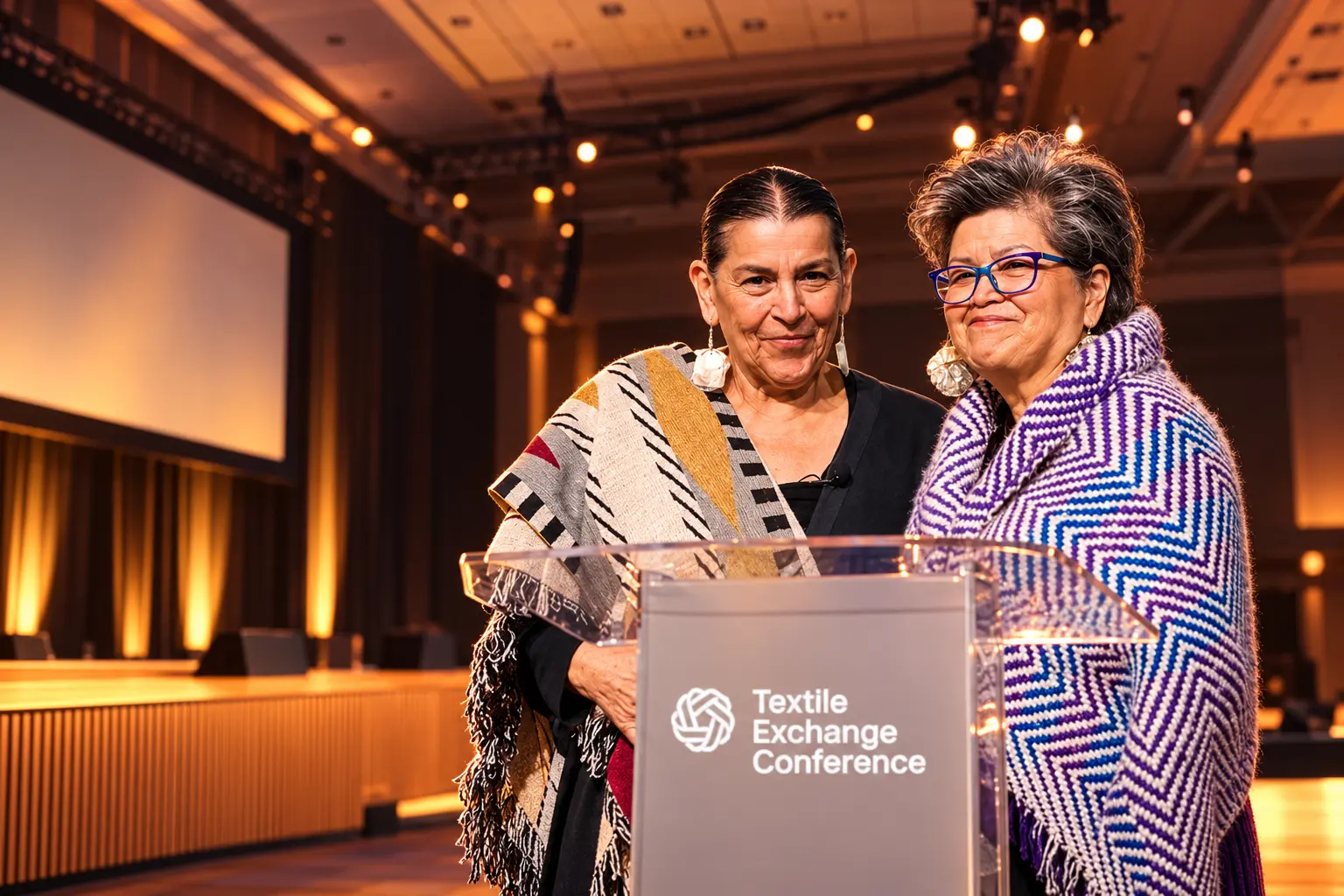
The conference sat on the unceded territories of the Musqueam, Squamish and Tsleil-Waututh nations. Chief Janice George, a master weaver, co-founder of L’hen Awtxw Weaving House, and a hereditary chief of the Squamish Nation, opened with Debra Sparrow, co-founder of Salish Blanket Co. George spoke in the register the rest of the week kept trying to translate into KPIs: the seventh generation principle.
Mother Earth knows how to take care of herself. It’s humans that need to learn how to work with Mother Earth. How do we use our resources in an intelligent way that takes care of the next generations?
Chief Janice George, master weaver and hereditary chief, Squamish Nation, Textile Exchange Conference, Vancouver
Bergkamp’s close asked the community to fight for the next 20 percent of preferred share, then the 20 percent after that. Materials Matter becomes effective on December 31, 2026. The fiber pile that has to move is already 139 million tonnes, and preferred systems still hold 20 percent of it.
Frequently Asked Questions
When Does Textile Exchange’s Materials Matter Standard Take Effect?
The standard becomes effective on December 31, 2026, and mandatory on December 31, 2027, and it replaces the Global Recycled Standard, the Recycled Claim Standard, and the Responsible Wool, Mohair and Alpaca Standards. 2026 is a prep year for certification bodies; 2027 is an optional audit year so farms and recycling plants that are ready can move before the mandate.
What Does Preferred Fiber Mean in These Figures?
In the Materials Benchmark, preferred fiber means cotton, polyester, nylon, viscose and wool bought through standards, certifications or other programs that verify production practices, not a single claim such as organic, recycled or regenerative on its own. Starting in 2027, annual reporting of raw material use through the Benchmark becomes mandatory for brand and retailer members of Textile Exchange’s Action Cohort, which will also have to set targets for verified sourcing.
How Many Viscose Producers Does Canopy’s Hot Button Report Rate?
Canopy rates 28 man-made cellulosic fiber producers, and more than 550 brands in the CanopyStyle initiative use the report to guide purchasing. The new criteria, announced in Vancouver on October 15, will be applied first in the 2027 Hot Button Report, with a simpler three-colour shirt rating and an automatic red score for unresolved ancient and endangered forest risk.
Why Is Most Recycled Polyester Still Made From Plastic Bottles?
Textile Exchange estimates that 3 percent of global recycled polyester production came from textile sources in 2025, equal to 0.3 percent of all polyester, because bottle collection is already industrial and garment collection is not. Among Benchmark brands, only 1.5 percent of the recycled polyester they used came from textiles, equal to 1.1 percent of all polyester those companies bought.
What Share of Reporting Brands Have Climate Targets Versus Nature Targets?
In 2025, 92.4 percent of Materials Benchmark participants reported formal climate targets, while formal nature targets rose from 22.3 percent in 2024 to 27.8 percent. Among companies that use animal fibers, 88 percent had an animal welfare policy, a much higher share than those with nature targets covering land and biodiversity.

Kering’s Growing Houses Cannot Outrun a Shrinking Gucci

Studio Staff and Bitcoin Buyers Built the Eminem Leak Case

A Mutated H1N1 Strain Is Hitting Younger Immunity First

Albert Heijn Returns at One-Third as Rivals Take Share

Art Basel Paris Ends After One Public Day

Thameslink Will Pad 60,000 Ironing-Board Seats From 2027

How Tall Was Adolf Hitler Really? Debunking the Myth of his Height

Micron Sells the Memory Shortage as Five-Year Contracts

Royal Caribbean Sends Los Angeles Ships to Singapore and Brisbane

U.S. Forces Clear Hormuz Mines, Then Hit Minelayers Again
-
 NEWS2 months ago
Thameslink Will Pad 60,000 Ironing-Board Seats From 2027
-
 SCIENCE3 years ago
How Tall Was Adolf Hitler Really? Debunking the Myth of his Height
-
 NEWS2 months ago
Micron Sells the Memory Shortage as Five-Year Contracts
-
 NEWS2 months ago
Royal Caribbean Sends Los Angeles Ships to Singapore and Brisbane
-
 BUSINESS2 months ago
U.S. Forces Clear Hormuz Mines, Then Hit Minelayers Again
-

 BUSINESS2 months ago
Sweetmore Bakeries Buys Fantasy Baking for Bar Work
-

 BUSINESS2 months ago
L Catterton Installs a Kraft Heinz Operator at Kettle Cuisine
-

 NEWS2 months ago
CISA’s 100 Water System Hacks Hit One-Operator Plants