
BUSINESS
Xi Asks Trump to Oppose Taiwan Independence After the Arms Freeze
Xi asked Trump at the White House to oppose Taiwan independence, while a $14 billion arms package stays frozen as a China chip.

Xi Jinping asked President Donald Trump on Thursday to oppose Taiwan independence, China’s foreign ministry said, after White House talks that produced no US readout.
The ask landed during an official state visit on September 24, Xi’s first at the White House in 11 years, while a $14 billion US missile-defense package for Taiwan stayed unsigned. Trump has already called that hold a bargaining chip with Beijing.
Xi Asked Trump for a Verb Washington Has Long Avoided
The closed-door meeting ran less than two hours. Trump told reporters afterward that it had been a “great meeting.” He did not answer shouted questions on Taiwan. Xi did not answer them either. China’s English readout, posted the next morning, filled the gap Washington left blank.
It is hoped that the U.S. side will adhere to the correct position of opposing Taiwan independence, and handle the Taiwan question with caution, so as to lay a solid foundation for China-U.S. strategic cooperation and the development of bilateral relations.
Xi Jinping, Chinese foreign ministry readout of White House talks
That sentence is the product Beijing wanted on paper. For years the United States has said it does not support Taiwan independence. Oppose is a different verb. Jennifer Welch, who served as director for China and Taiwan on the National Security Council, said a switch “would be meaningful” even if it looked like wordplay, because Beijing would use it to shake Taiwan’s confidence in US support. “Opposing Taiwan independence implies an active effort to contain what Beijing sees as pro-independence forces,” she said.
Jeremy Chan, senior China analyst at Eurasia Group, said the same shift would eat into the strategic ambiguity over whether the United States would come to Taiwan’s aid. Beijing made the private version of this ask of the Trump administration in 2025. Thursday was the first time Xi put it to Trump in public, on US soil, and then printed it.
The State Department’s public Taiwan fact sheet, updated in February 2025 in what the department called a routine refresh, no longer carries the older line that Washington does not support independence. It still says the United States opposes unilateral changes to the status quo from either side and expects a peaceful settlement. Xi is not asking Trump to restore the dropped line. He is asking him to go past it, and to do so after two summits in which the live weapons file stayed in the drawer.
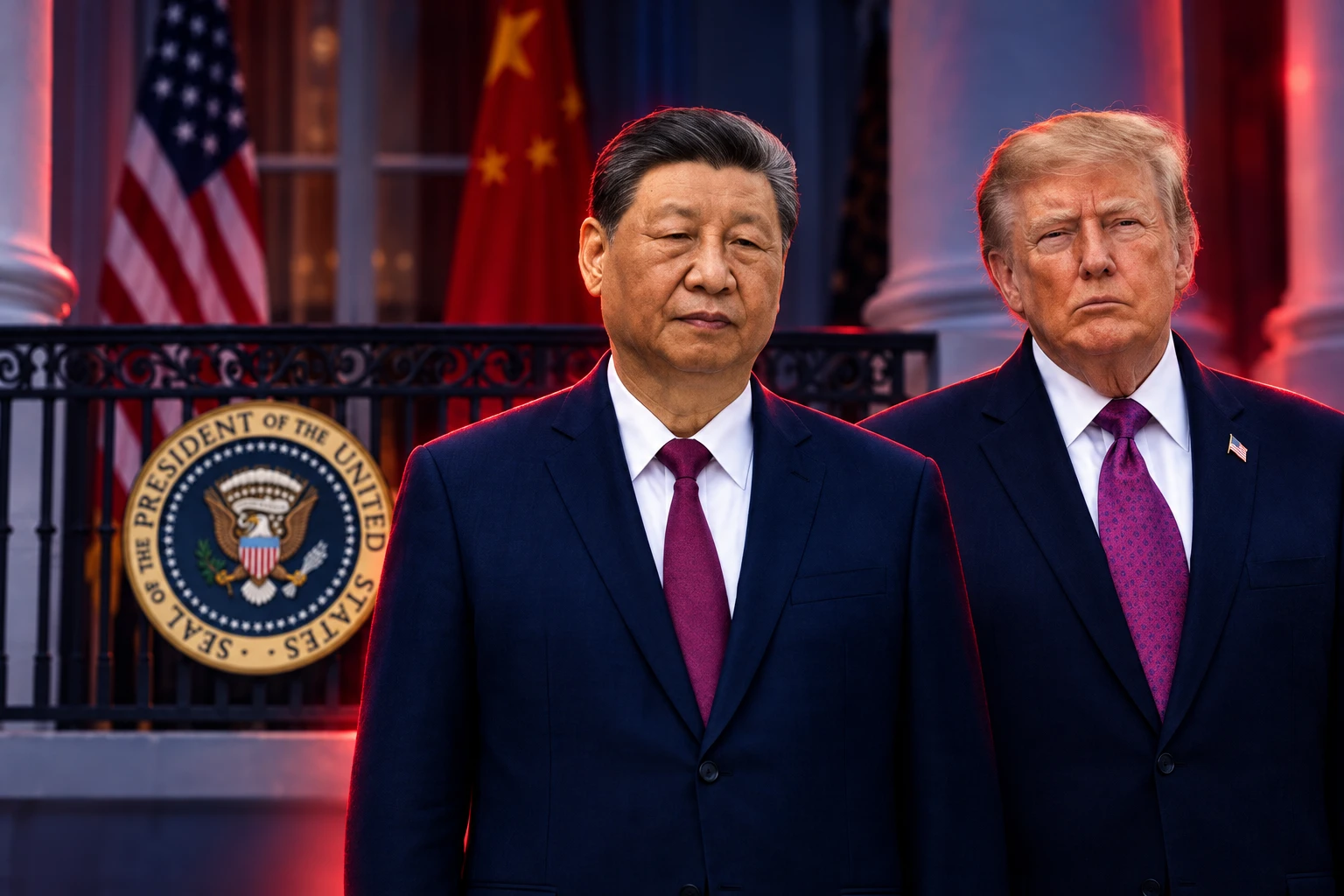
The $14 Billion Missile Package Is Still Unsigned
The package Congress reviewed in January is built around missile defense: Patriot PAC-3 interceptors, NASAMS launchers, and gear to knock down drones. It has not been notified. A separate sale, $11.1 billion covering HIMARS launchers, Paladin howitzers, Javelin and TOW missiles, and ALTIUS drones, was notified on December 17, 2025, and remains the largest Taiwan FMS case by dollar value. The fight this week is not that file. It is the next one.
THE TWO PACKAGES AND THE MONEY STILL PARKED
| Item | Value | Status | What it buys |
|---|---|---|---|
| December 2025 FMS | $11.1 billion | Notified to Congress | HIMARS, Paladin howitzers, Javelin, TOW, ALTIUS drones |
| Missile-defense FMS | $14 billion | Unsigned after January review | PAC-3 interceptors, NASAMS, anti-drone systems |
| Other stalled accounts | $300 million FMF; $1 billion TSCI | Appropriated, not obligated | Foreign military financing and the Taiwan Security Cooperation Initiative |
After the May meeting in Beijing, Trump said he was holding the $14 billion sale “in abeyance” and that it “depends on China.” He called it “a very good negotiating chip for us, frankly” and “a lot of weapons.” He raised the same file with Xi then. He went into Thursday’s talks with it still unsigned. A White House official said before the Washington visit that Trump would decide in a fairly short time. The Chinese readout of the talks does not record a decision.
Taiwan’s legislature in May approved $25 billion in special funds to pay for US weapons, including money meant for purchases still waiting on Washington. Taipei did its part of the paperwork. The notification that would turn the $14 billion case into a live sale is the part that never left the building.
Rubio Blames US Missile Stocks for the Hold
Secretary of State Marco Rubio, who also serves as White House national security adviser, gave the administration’s public reason the day before Xi arrived. Speaking to reporters in New York, he framed the delay as a factory-floor problem, not a Taiwan-specific concession.
This is not about Taiwan in specific, but when we sell something, that means we don’t have it anymore. We can get it in the future, but we don’t have it now.
Marco Rubio, secretary of state, to reporters in New York
PAC-3 interceptors are the same rounds the US Army wants on its own launchers. A hold sold as inventory math can still function as a political pause when the president has already told a television audience that the same case depends on China. Both statements describe the unsigned package. They answer different questions: whether the rounds exist in stock, and whether Beijing is in the room when the case moves.
Four Republican senators did not buy the wait. On September 23, Mitch McConnell, John Cornyn, Lisa Murkowski, and Thom Tillis wrote to Rubio and Defense Secretary Pete Hegseth about what they called more than $15 billion in stalled national security assistance for Taiwan, the three lines in the table above counted together.
WHAT THE SENATE LETTER SAYS IS STUCK
- Foreign military financing: $300 million appropriated for fiscal 2026 has not been obligated.
- Taiwan Security Cooperation Initiative: $1 billion appropriated at the Defense Department has not been obligated.
- The $14 billion FMS case: still withheld from final approval after the January congressional review.
The Taiwan Relations Act tells the executive branch to make defense articles available so Taiwan can keep a sufficient self-defense capability. It does not say those articles may sit as a chip in a trade round. China’s defense ministry, hours around the summit, told Washington to use “extreme caution” on arms sales to Taiwan. Pre-summit briefings said Xi would also lean on the 1982 US-China communique, which spoke of reducing arms sales over time. The published Chinese readout of Thursday’s talks does not repeat that demand. It repeats the independence verb.
244 Government Ships Closed a Ring in July
While the FMS file sat in Washington, Beijing practiced a different kind of pressure around the island that makes the world’s most advanced chips. Taiwan’s Coast Guard Administration recorded a record 244 Chinese coast guard, research, and other government ships around the main island in July, about 60 percent of them coast guard hulls, an average of nearly eight a day. Warships, which already sail near-daily, were not in that count.
THE SHIP COUNT THROUGH SUMMER
- May 2026: 30 Chinese government ships detected around Taiwan.
- June 1, 2026: China Coast Guard pairs begin the first continuous patrols in waters east of the island, a presence later rotated on July 4 and again on August 4.
- June 6-10, 2026: civilian law-enforcement ships, under coast guard escort, hail passing cargo traffic; Chinese state media claim 198 checks and three “corrected” violations.
- June 2026: 55 government ships detected, up from 30 in May and from 58 in July 2025.
- July 2026: 244 government ships, the record month.
- August 1-21, 2026: 152 more detections in three weeks.
The Institute for the Study of War assessed that Beijing has very likely set a standing “law enforcement” presence and regular surveys in the waters east of Taiwan, out to about 200 nautical miles, the Pacific lanes a blockade would have to close. Those continuous coast guard patrols east of Taiwan look more like the Senkaku and Scarborough playbook (stay until the other side treats the water as yours) than a one-off drill. Radio checks on merchant ships are not boardings. They are the step before boardings.
A freeze on PAC-3 rounds does not move those hulls. It does tell Taipei, during the same season the hulls set a record, that the next US interceptor case is a variable in a US-China bargain.
Taipei Rejects Beijing’s Version of the Talks
Taiwan’s Ministry of Foreign Affairs answered on Friday, after the Chinese readout, not after a US one. The ministry said Xi’s remarks were “the consistent Chinese approach of distorting facts and unilaterally conveying its position and claims.” It said the Republic of China and the People’s Republic of China are not subordinate to each other.
“Taiwan’s sovereignty belongs to all the people of Taiwan. The Chinese Communist Party has no right to represent the Taiwanese people, and Taiwan’s future can only be determined by the Taiwanese people through democratic means,” the ministry said. It called China the “true disruptor” of regional peace, pointing to military pressure around Taiwan and in the East and South China Seas, and said more than 60 US senators and representatives had voiced support for Taiwan ahead of Xi’s trip.
Hsiao Kuang-wei, the ministry spokesperson, said the Chinese press release was the usual tactic of making claims by distorting the facts. President Lai Ching-te’s government rejects Beijing’s sovereignty claim. Outside the White House on Thursday, Wang Dan, a student leader of the 1989 Tiananmen protests, said the wishes of Taiwan’s 23 million people must be respected and that the island’s priority now should be strengthening its defenses.
Taipei’s problem is not that it misread the Chinese sentence. It is that Washington still has not put an English sentence of its own next to it. In a closed meeting, the side that publishes first writes the first draft of what was said.
Washington’s One China Policy Stops Short of Beijing’s Claim
Beijing’s One China principle says Taiwan is an inalienable part of the People’s Republic. The US One China policy, as the US-China Economic and Security Review Commission lays out, does not take a position on sovereignty over Taiwan. Washington “acknowledges” Beijing’s view that there is one China and that Taiwan is part of China. It does not endorse that view. The policy is guided by the Taiwan Relations Act of 1979, the three joint communiques, and the Six Assurances of 1982.
The commission notes a translation trap that is older than this summit. In the 1978 communique, the English “acknowledges” became chengren in Chinese, a word that reads as “recognize,” a harder concession than the 1972 rendering renshi, “to be aware of.” Getting Trump to say “oppose independence” would give Beijing another English verb it can treat, in Chinese, as a commitment to police Taiwan’s politics. That is the second-order use of Thursday’s sentence: not a press-release win for the day, a citation for the next crisis.
When the United States recognized Beijing and ended formal ties with Taipei in 1979, Congress wrote the Taiwan Relations Act to keep arms and a residual US capacity to resist coercion in the file. Xi’s readout ties the correct position of opposing Taiwan independence to “strategic cooperation” and to the new trade arrangement the two sides announced. Treasury Secretary Scott Bessent said the trade truce was extended two months, until Jan. 10. The Chinese text puts Taiwan in that same basket of things to handle “with caution” so the rest of the relationship can move.
Ryan Hass, director of the China Center at the Brookings Institution, said before the result was known that “the key acid test will be what Trump says on Taiwan,” not only what Xi urges him to endorse. Trump’s public answer on Thursday was no answer. China’s public answer was the verb.
What the White House Left Unsaid on Taiwan
The White House posted arrival-ceremony details, a Marine One lawn tour, and state-dinner notes. It did not post a readout of the Taiwan exchange. Xi’s ministry did. Taipei had to answer Beijing’s version of a US meeting. The $14 billion case went into the visit unsigned and, on the public record, came out the same way.
WHAT WE KNOW
- The ask: China’s foreign ministry says Xi told Trump to oppose Taiwan independence and handle the issue with caution.
- The US line in public: Trump called the meeting great and did not answer Taiwan questions; no White House readout of the closed-door exchange has been issued.
- The weapons file: the $14 billion missile-defense case remains unsigned after January’s congressional review and after the May Beijing summit.
- The ships: July’s 244 government vessels set a record around Taiwan, and coast guard patrols east of the island have been running in monthly rotations since June 1.
WHAT IS UNCONFIRMED
- Private wording: whether Trump accepted, rejected, or ignored Xi’s verb inside the room.
- The 1982 arms language: whether Xi invoked a halt or a drawdown of sales, a demand briefed before the visit but absent from the published Chinese readout.
- The next notification: whether the $14 billion case moves in the coming weeks, slips to year end, or stays tied to the extended trade truce.
Beijing can already tell a domestic audience that Washington held the missiles through two leader visits. It would rather add a US president’s voice saying “oppose.” Until that voice shows up, or the PAC-3 case is notified, the record of this summit on Taiwan is a Chinese sentence and an American silence.

Kering’s Growing Houses Cannot Outrun a Shrinking Gucci

Studio Staff and Bitcoin Buyers Built the Eminem Leak Case

A Mutated H1N1 Strain Is Hitting Younger Immunity First

Albert Heijn Returns at One-Third as Rivals Take Share

Art Basel Paris Ends After One Public Day

Thameslink Will Pad 60,000 Ironing-Board Seats From 2027

How Tall Was Adolf Hitler Really? Debunking the Myth of his Height

Micron Sells the Memory Shortage as Five-Year Contracts

Royal Caribbean Sends Los Angeles Ships to Singapore and Brisbane

U.S. Forces Clear Hormuz Mines, Then Hit Minelayers Again
-
 NEWS2 months ago
Thameslink Will Pad 60,000 Ironing-Board Seats From 2027
-
 SCIENCE3 years ago
How Tall Was Adolf Hitler Really? Debunking the Myth of his Height
-
 NEWS2 months ago
Micron Sells the Memory Shortage as Five-Year Contracts
-
 NEWS2 months ago
Royal Caribbean Sends Los Angeles Ships to Singapore and Brisbane
-
 BUSINESS2 months ago
U.S. Forces Clear Hormuz Mines, Then Hit Minelayers Again
-

 BUSINESS2 months ago
Sweetmore Bakeries Buys Fantasy Baking for Bar Work
-

 BUSINESS2 months ago
L Catterton Installs a Kraft Heinz Operator at Kettle Cuisine
-

 NEWS2 months ago
CISA’s 100 Water System Hacks Hit One-Operator Plants