
NEWS
Air Force DASH Sprint Opens a Government-Owned C2 Layer
The latest Air Force DASH sprint put a Space Force Guardian over a joint crew to prove vendors can snap into a government C2 layer.

The Department of the Air Force said Sept. 8, 2026 that its latest DASH sprint ran a joint crew under a Space Force Guardian on a government-owned software layer. The two-week Decision Advantage Sprint for Human-Machine Teaming put Air Force battle managers and industry coders on the same floor at Nellis.
Officials did not publish new speed scores. They described a plug-and-play path that is supposed to carry vendor tools onto classified networks, where crews would use them in a high-end fight.
A Guardian Ran the Crew at Nellis
The sprint was hosted by the 805th Combat Training Squadron, Air Combat Command’s C2 experimentation hub, known as the Shadow Operations Center-Nellis. The Advanced Battle Management System Cross-Functional Team and the Air Force Research Laboratory co-led what they called a whole-of-lab event.
Photos from the floor are dated July 22 and July 23, 2026, which places the two-week run in midsummer, after May’s Multi-Decision Advantage Sprint for Human-Machine Teaming. In that earlier event, Guardians sat with Airmen for the first time. This time a Guardian led the integrated crew.
Lt. Col. Corey Ellsworth, ABMS Cross-Functional Team integration lead, said the goal is to get advanced tools to the joint force at speed. He said the whole setup was built so that once a tool is validated on this floor, crews can transition validated tools to classified networks and actually use them in a fight.
U.S. Space Force Maj. Erik Murdock, 57th Space Aggressor Squadron Operations Division chief, treated the joint crew as the point, not the novelty of a Guardian in the lead seat.
As a joint force, we operate as a single, cohesive team focused on the exact same objective. It isn’t about the ‘Air Force way’ or the ‘Space Force way’; it is about the ‘warfighting way.’ Because while our domains are different, our decision-making challenges are identical. This experiment demonstrated that when you give a joint team common objectives and a shared set of tools, the integration happens naturally.
Maj. Erik Murdock, 57th Space Aggressor Squadron Operations Division chief, DASH experiment
Lt. Col. Wesley Schultz, 805th CTS commander, said ShOC-N veteran operators built the scenarios from more than 50 years of collective tactical and operational C2 work. Geography, logistics, and live changes to the rules of engagement were written in on purpose. “This isn’t a scenario from a video game; it is one crafted to challenge operators and engineers alike,” Schultz said.
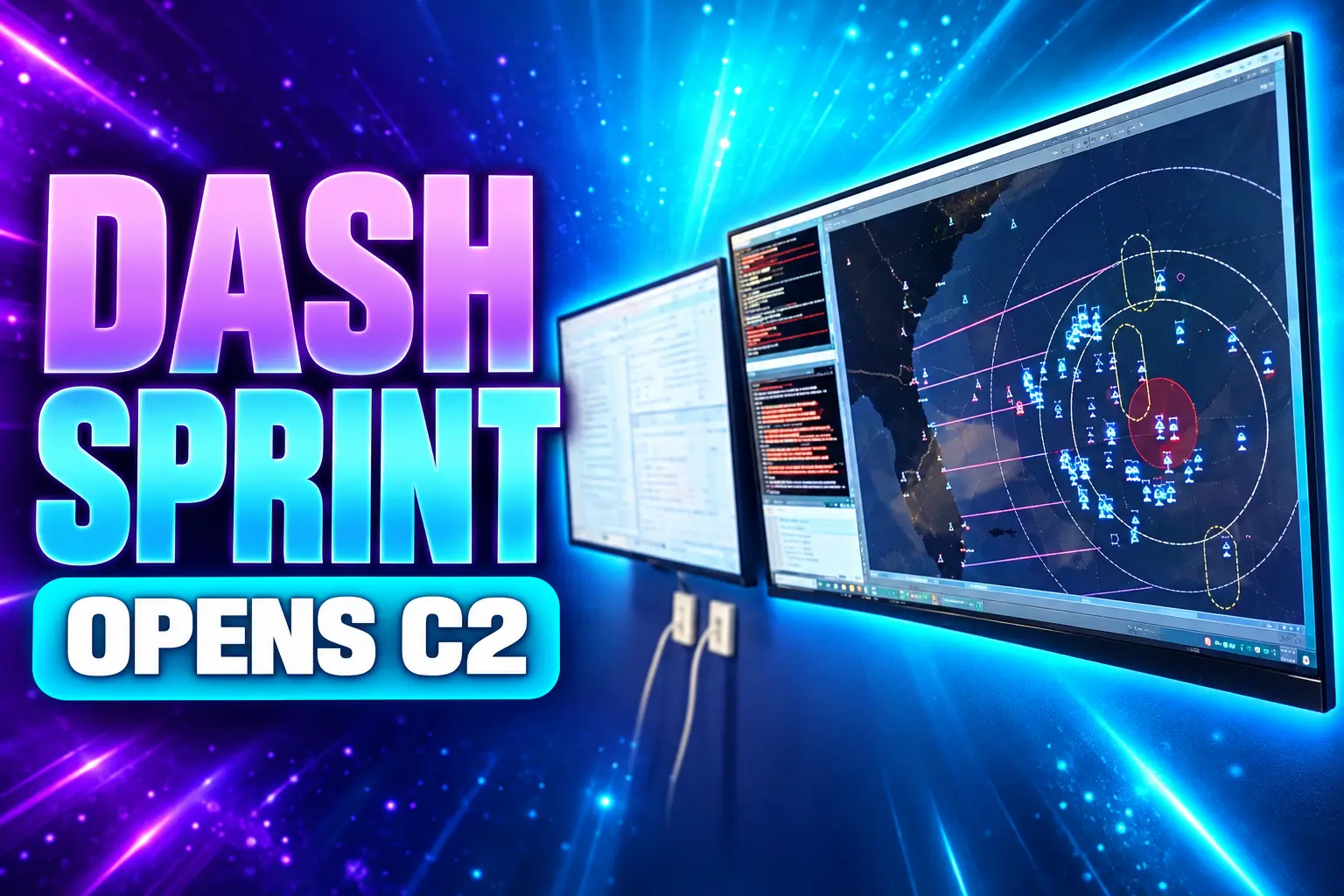
AFRL Built a Government-Owned Plug for Vendors
The technical backbone was an AFRL-written “orchestrator,” a government-owned software interface that let several competing industry apps run in one modular setup. Kevin McFarland, AFRL Advanced Capabilities Directorate project management lead, called a working plug-and-play run a critical milestone.
WHAT THE GOVERNMENT LAYER CHANGES
- The interface: AFRL owns the orchestrator, so vendor tools talk through a government plug instead of a private stack.
- The competition: Multiple industry apps can be swapped through that plug in the same trial, which is the point of keeping the box in government hands.
- The metrics: Ryan Hilliard, AFRL Information and Spectrum Warfare Directorate C2 research area lead, said lab software scored baseline runs and vendor runs in real time so crews and coders saw the same trial numbers on the floor.
- The handoff: Unclassified lab trials are meant to move, after a pass, onto classified warfighting nets rather than sit as demo code.
Jeffrey Palumbo, AFRL C3BM capability area lead, said that user-producer co-creation is the acquisition model C3BM wants: proof of concept, an energized industrial base, and early operator notes that shape the next build. “It sets us up to deliver chunks of warfighting capability to the operational force in a rapid and repeatable cycle,” Palumbo said.
Government ownership of the orchestrator significantly decreases integration bottlenecks. We are no longer locked into a single vendor’s closed architecture.
Kevin McFarland, AFRL Advanced Capabilities Directorate project management lead, DASH experiment
Col. John Ohlund, ABMS CFT director, had already described that plug in June after MASH. He said AFRL’s orchestrator let different companies exchange data, ontologies, and metadata, and that a modular approach lets the government pick best-of-breed services as they mature. Vendors watching these sprints already read each request as a shopping list for interchangeable tools. That is the market the government layer is built to create.
How Fast the Earlier Sprints Already Moved
This release did not add a new timing score. The Air Force has already published those numbers from the 2025 sprints, which is why the July event could spend its public capital on architecture instead of another stopwatch claim.
DASH 1, held at the Howard Hughes Operations Center in Las Vegas in April 2025, focused on Perceive Actionable Entity, the choice of which actions are possible, permissible, and desirable against a target, a rescue, or a resupply. Four industry teams and a ShOC-N coding team worked with U.S. and Canadian air battle managers. Crews first ran a scenario with existing tools, then ran a similar one with prototype aids built during the sprint.
Col. Christopher Cannon, then ABMS CFT lead, said the first sprint produced a seven-fold drop in decision time. Software machines answered more than twice as many dilemmas as humans alone, and the microservices produced three times as many valid solutions, which the team called Battle Effects. Machine errors, he said, were on par with human errors after a week of coding.
THE DASH SERIES SO FAR
| Sprint | When | Job for the software | Result officials cited |
|---|---|---|---|
| DASH 1 | April 2025 | Perceive Actionable Entity | seven-fold faster decisions; more than twice as many dilemmas; three times the valid Battle Effects |
| DASH 2 | 2025 | Match effectors to targets | Recommendations in less than 10 seconds; 30 times more options; two vendors each more than 6,000 solutions for roughly 20 problems in one hour; validity from 70 percent to more than 90 percent after one algorithm change |
| DASH 3 | December 2025 | Battle courses of action | Six industry teams plus a lab team; U.S., UK, and Canadian operators; weather treated as a live dilemma |
| MASH | May 2026 | All three functions in one ensemble | First Guardians in the seat with Airmen; four allied nations observed |
| Latest DASH | July 2026, released Sept. 8, 2026 | Joint crew on the government orchestrator | Guardian-led crew; plug-and-play milestone; game-theory problems; no new speed score published |
DASH 2, with seven teams (six industry and one military innovation team), asked software to pick the best available weapon for an identified target. Air Force public affairs said machines produced recommendations in less than 10 seconds and generated 30 times more options than human-only teams. Two vendors each produced more than 6,000 solutions for roughly 20 problems in one hour. Accuracy sat with human performance after two weeks of development, and one algorithm change would have lifted recommendation validity from 70 percent to more than 90 percent.
DASH 3 in December 2025 moved to full battle courses of action, including long-range kill chains, electromagnetic battle management, space activity, and cyber options. UK and Canadian operators sat in the same rotation as U.S. crews. In March 2026, Lt. Col. Shawn Finney, then ShOC-N commander, said the 2025 run was strong enough that the series would return in 2026 with three events beginning in May. MASH was that May event. The July sprint is the next one on that calendar.
Air and Space Share the Same Decision Bind
The 711th Human Performance Wing measured operator workload on the July floor. Dr. Elizabeth Frost, the AFRL DASH lead, said quantitative data and direct observation backed a blunt hypothesis: the cognitive bind on a battle manager does not change with the domain.
“Our data and direct observations confirm that the fundamental cognitive challenges for a battle manager are domain-agnostic,” Frost said. Airmen and Guardians both have to pull huge, messy data together and rank actions under time pressure. A well-built human-machine team, she said, frees some of that load.
That finding is why a Guardian could lead an Air Force crew without a separate “space” playbook. In May, Guardians operated the tools in the seat for the first time and, in Ohlund’s words, helped package multi-domain options a commander could actually pick. An air battle manager still cannot execute a space or cyber effect, he said. The job is to prepare the menu. The bet is that the computers ruminate over every possible multi-domain effect so the right commander sees a ranked list sooner.
U.S. Space Force 1st Lt. Abby Warner, 16th Electromagnetic Warfare Squadron deputy flight commander, said after MASH that air-domain tempo, synchronization, and rapid course-of-action work matched what Space Force needs in a contested electromagnetic fight. “Turns out our decision-making headaches are similar across domains, and Transformational Model-based services adapt quickly to space ops,” Warner said.
The Transformational Model for Decision Advantage, which ABMS CFT has been testing as a government reference architecture, maps more than 50 C2 decision points so crews can see where a machine should help and where a human should keep the last word. Ohlund has described the shift in plain terms. Human-in-the-loop still means a person helps create the decision. Human-on-the-loop means the computer recommends, triages, ranks, and sequences, and the person makes the final call. Finney, speaking in March 2026, said the human remains the final decision-maker even as the number of available decisions keeps rising.
The Battle Network Is Built for Low Switching Costs
Col. Rowland Cardoni, C3BM Operational Response Team chief, said AFRL’s presence at these events has let his team project transition opportunities onto the broader Department of the Air Force Battle Network. That network is the actual destination. The Nellis floor is the on-ramp.
WHERE THE SPRINT IS SUPPOSED TO LAND
- The network: The DAF Battle Network is the department’s system of systems tying sensors, effectors, and logistics to faster decisions, and it is the Air Force and Space Force contribution to Combined Joint All-Domain Command and Control.
- The stack: C3BM says the network roughly 50 programs of record across the department, and that the architecture has to take in new software, algorithms, and data flows at low switching costs.
- The office: ABMS work began in 2018. The secretary of the Air Force stood up the C3BM portfolio acquisition executive in September 2022 to deliver that network rather than a single closed program.
- The method: C3BM calls its delivery model best of breed, which is the same idea as McFarland’s government-owned plug: swap a better module without rebuilding the box.
U.S. Space Force Col. Teina Stallings-Lilly, ABMS CFT deputy director for space operations integration, said after MASH that Guardians in the seat were there to help build an integrated DAF Battle Network, not to watch an Air Force demo. Ellsworth added that software tested in these sprints is meant to translate to Navy, Marine Corps, and Army partners. The classified-network sentence in the September release is the same claim in operational language: if the plug only works on an unclassified Las Vegas floor, it is still a science project.
The Howard Hughes Operations Center, ShOC-N’s unclassified software shop in downtown Las Vegas, exists so industry can code without a clearance wall on day one. That is also why Canada sat in DASH 1 and why the UK and Canada sat in DASH 3. Allies can enter the unclassified loop. The hard step Cardoni is projecting is the later hop onto classified Air Force and Space Force nets, with the C3BM Operational Response Team watching for tools that can survive that hop.
Col. Ohlund Wants Problems With No Perfect Answer
Schultz called the sprints the biggest shift in battle management in his career, saying crews are shaping what the tech allows so it magnifies skills and training rather than replacing them. The next argument from the ABMS CFT is narrower, and harder to score with a stopwatch.
“The future of battle management isn’t just about accelerating our reaction time; it’s about fundamentally changing how we make decisions,” Ohlund said. “The experimentation focused on game theory and will continue in future experiments, too.” Crews are being pushed past simple, reactive runs into ambiguous problems with trade-offs and no perfect answer. He said that mix is what a peer fight will demand if the joint force has to out-think and outmaneuver an adversary, not only out-click one.
That is why this release reads differently from DASH 1 and DASH 2. Those events sold volume and speed. This one sold a Guardian in the lead seat, a government-owned plug, and a path onto the Battle Network, then pointed at game theory as the problem set that will keep coming back. ABMS CFT, the C3BM portfolio acquisition executives, and AFRL are already lined up for that next cycle. The unclassified floor can show that vendor tools snap in. The fight they keep describing still lives on the other side of the classified handoff.

Southwest Lounges Will Open Behind a New Chase Card

Air Force DASH Sprint Opens a Government-Owned C2 Layer

AI Wildfire Detection Satellites Force a Carbon Recount

Gulf Oysters Take the Blame for a Wound-Borne Scare

Matt Clifford Leaves the ARIA Chair After Anthropic Dual Role

Burger King Rebuilds Chicken Nuggets After Calling Them Rubbery

Twenty Controllers Closed Norwich Airport for a Bank Holiday

Thameslink Will Pad 60,000 Ironing-Board Seats From 2027

Royal Caribbean Sends Los Angeles Ships to Singapore and Brisbane

Micron Sells the Memory Shortage as Five-Year Contracts
-
 BUSINESS2 weeks ago
Burger King Rebuilds Chicken Nuggets After Calling Them Rubbery
-
 NEWS2 weeks ago
Twenty Controllers Closed Norwich Airport for a Bank Holiday
-
 NEWS2 weeks ago
Thameslink Will Pad 60,000 Ironing-Board Seats From 2027
-
 NEWS2 weeks ago
Royal Caribbean Sends Los Angeles Ships to Singapore and Brisbane
-
 NEWS2 weeks ago
Micron Sells the Memory Shortage as Five-Year Contracts
-
 BUSINESS2 weeks ago
Sweetmore Bakeries Buys Fantasy Baking for Bar Work
-
 BUSINESS3 weeks ago
U.S. Forces Clear Hormuz Mines, Then Hit Minelayers Again
-

 NEWS2 weeks ago
Frontier Miles Cuts Basic Fares After the Barclays Pact