
ENTERTAINMENT
Paramount Clears the Warner Deal With a Five-Year Quota
Twelve states dropped their block of Paramount’s Warner Bros. deal for a five-year film quota and a $30 million miss fee, not a breakup.

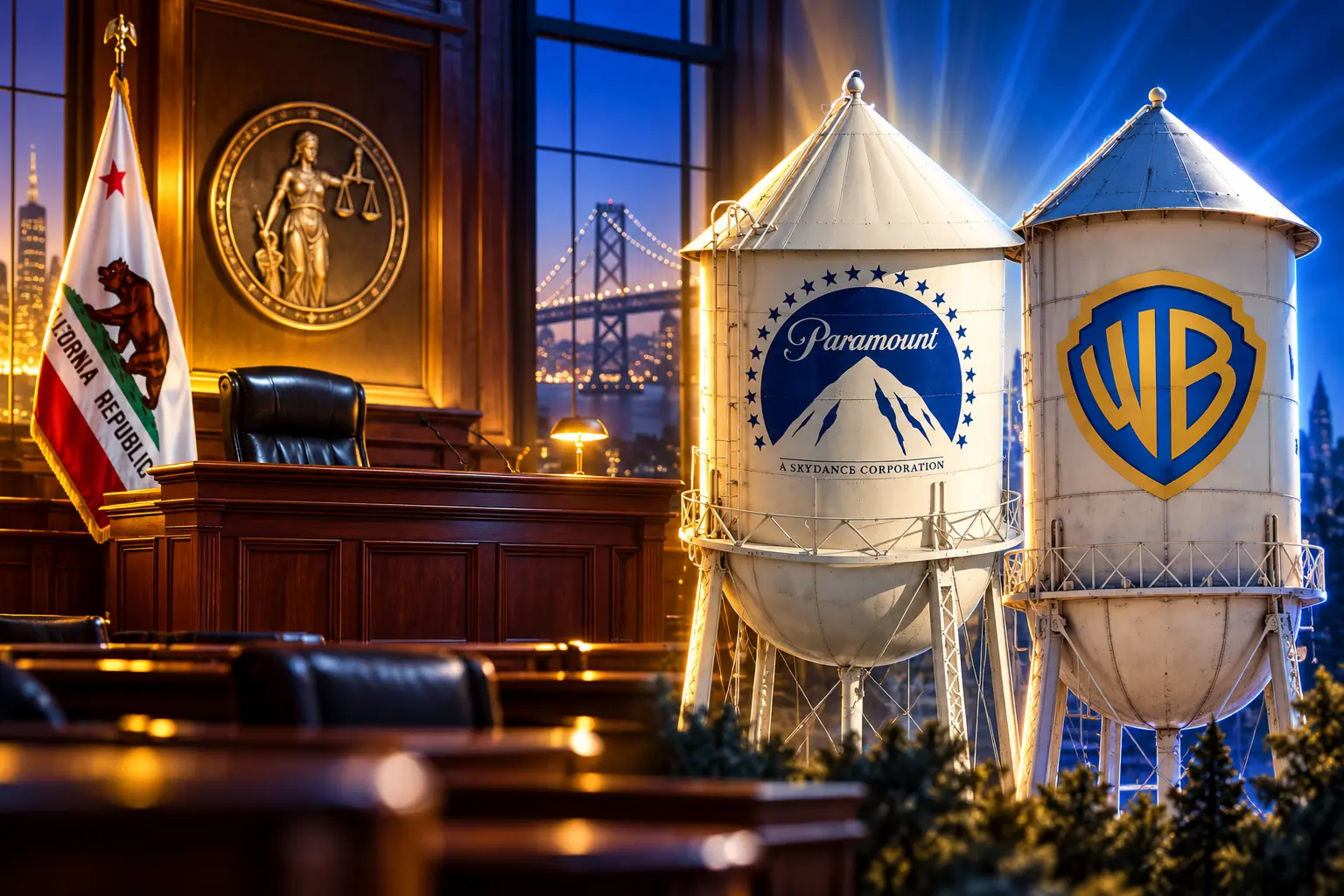
Paramount Skydance settled a 12-state antitrust case on September 21, 2026, clearing a path to buy Warner Bros. Discovery. The cash deal is $31 a share, about $81 billion of equity and $110 billion of enterprise value. A federal judge in San Francisco still has to enter the consent decree before the companies can close.
The states did not force a sale of CNN, CBS, or the cable networks. They converted a lawsuit that sought to stop the merger into a five-year operating order: a theatrical quota, a $30 million fee for each missing film, extra U.S. production spending, and a news board for CNN and CBS.
A $7 Million Clock Closed the Case
The bargaining did not turn on a new theory of Hollywood competition. It turned on a calendar. If the merger is still open after September 30, 2026, Warner Bros. Discovery shareholders collect a ticking fee of $0.25 a share each quarter, about $7 million a day, under the merger agreement David Ellison, Paramount’s chairman and chief executive, described on a March 2, 2026 investor call.
Paramount had already told the court that the pause was expensive. In a September 8 filing it said the state and Writers Guild suits were the last barrier after regulators were done, and it put delay costs reaching up to $1.88 billion on the table while asking that the plaintiffs post a bond. The company said it had clearances from regulators in 69 jurisdictions. The Hart-Scott-Rodino waiting period in the United States had already expired.
HOW THE CASE RAN OUT OF CALENDAR
- February 27, 2026: Paramount and Warner Bros. Discovery sign a $31-a-share cash merger. Paramount has already paid the $2.8 billion fee Warner Bros. owed Netflix to walk away from a rival deal.
- July 13, 2026: California and 11 other states file in the U.S. District Court for the Northern District of California, arguing the combination would cut film output and raise prices for theaters, pay-TV distributors, workers, and viewers.
- July 24, 2026: The states, the Writers Guild of America, and the companies stipulate that the merger will not close until five days after a merits ruling, or until June 1, 2027.
- September 21, 2026: The states and Paramount file to settle. The Writers Guild settles the same day rather than try the case alone.
Four plaintiff states, Massachusetts, New York, Connecticut, and Minnesota, resisted a California-led draft over the prior weekend, then stood down. A trial had been pointed at March 2027. The Writers Guild, suing as a nonprofit, said a complex antitrust case through trial would cost millions of dollars with no government enforcers left in the room. The company racing a daily close fee could outlast the offices trying to stop it.
What the Consent Decree Requires
California Attorney General Rob Bonta led the coalition of 12 attorneys general that sued in July: Arizona, Colorado, Connecticut, Massachusetts, Minnesota, Nevada, New Jersey, New Mexico, New York, Oregon, and Washington. The settlement pending in San Francisco runs five years and is court-enforceable. It does not unwind the studios, the streamers, or the newsrooms.
THE FIVE-YEAR FILM FLOOR
| Requirement | Years 1-2 | Years 3-5 |
|---|---|---|
| Theatrical releases | 30 a year | 32 a year |
| Wide releases | 20 | 21 |
| Independent films | At least 4 a year | At least 4 a year |
| U.S. film spend | $300 million more a year than 2025 | $300 million more a year than 2025 |
| Missed-film fee | $30 million per missing title | $30 million per missing title |
If the company misses the annual film count, Bonta’s office said it must divest Miramax Studios and pay $30 million per missing film toward healthcare and retirement trusts tied to the Writers Guild, IATSE, the Directors Guild of America, the Teamsters and other unions, and to the National Association of Attorneys General for antitrust work. The U.S. production floor is an extra $1.5 billion over five years above 2025 domestic spending, not a new total budget from zero.
The merged company also has to put $47.5 million into a workforce fund over five years for training and career help for workers displaced by the merger, honor existing union contracts, and bargain in good faith. It will run an independent-film purchase fund at $5 million a year, $25 million over the decree. An independent monitor watches compliance. For five years the Paramount and Warner Bros. basic-cable channels must be negotiated separately, without sharing confidential affiliate-rate information. A free streaming service in the mold of Pluto TV has to continue. The Melrose Avenue and Burbank lots stay open.
This settlement is not a vote of support for this merger. But we believe this settlement, which resolves our antitrust concerns in every market alleged in our case, protects competition and consumer choice, and puts workers’ needs, concerns, and futures first, is the best course of action.
Rob Bonta, California attorney general, September 21, 2026
The joint motion to enter the consent decree is the paper that would lift the July 24 no-close stipulation. Ellison said the same day that the company now has “complete clearance for this merger.” The judge has not signed.
The 30-Film Quota Was Already on the Table
The theatrical number that Bonta is selling as a win is largely a number Ellison had already put in public. After the states sued, Paramount said the combination would release at least 30 high-quality films annually with a 45-day theatrical window. On the March 2 call he split that as 15 films a year per studio and said Paramount had 15-plus titles dated for 2026, up from 8 theatrical releases in 2025, the year it combined with Skydance. Warner Bros. Pictures, he said, had just gone past $4 billion at the box office on the back of Superman, Minecraft, and Sinners.
The decree copies the 30 for the first two years, then raises the floor to 32, with 20 wide releases and then 21, plus four independents every year. That is a real bump in the out-years. It is also a headcount. The order does not say the films have to be good, expensive, or competitive with the titles a stand-alone Warner Bros. would have greenlit. It says they have to exist, and that a shortfall costs $30 million a title plus Miramax.
On a $110 billion enterprise-value company, that fee can be cheaper than financing, marketing, and releasing a true wide movie. The first reaction to the penalty, before Bonta even announced it, was that the slate would get padded with cheap product so the count clears. A quota that prices a miss, and that expires in five years, is a different instrument from a second studio still bidding against you in 2032.
Miramax Is the Only Asset on the Block
Classic merger remedies sell overlapping networks, studios, or library rights before closing. This one does not. The states’ original complaint said one owner of Paramount and Warner Bros. would hold too much power over movie supply, cable carriage, and the people who make the work. The paper they filed on September 21 leaves both lots, both film engines, both pay-TV bundles, and both news brands in place.
Miramax is the structural hostage, and only after a missed year of theatrical output. It is a famous label. It is not CNN. It is not HBO. It is not the Burbank lot. Court-enforced money and a possible later sale of one catalog are how the states chose to police a combination they had called illegal in July.
Bonta said people who would feel the deal first told his office they wanted consistent film output, domestic production, and paychecks. IATSE International President Matthew D. Loeb thanked him for protections for members. Directors Guild of America National Executive Director Russell Hollander said the commitments protect theatrical and television markets and domestic film jobs “during a period of decreased production,” and that the guild still wants to talk about domestic television. Those are labor terms. They are not a second buyer of scripts, star deals, or release dates.
CNN and CBS Remain One Owner’s Newsrooms
The news remedy is a News Editorial Independence Board meant to help CNN and CBS keep editorial independence. Connecticut Attorney General William Tong had wanted the news divisions sold. “Connecticut wanted and demanded full divestiture of CNN and CBS News,” he said. “We wanted to save ethical and independent journalism and news. We fought aggressively for that remedy. I am deeply disappointed that we could not do more.”
A board that referees bias fights inside a company that will own both CBS News and CNN is not a second owner. The five-year cable firewall is the same shape: Paramount and Warner Bros. basic channels still live in one firm, but their affiliate talks are supposed to look like two firms until the decree runs out. After that, the information wall is a memory and the subscriber bills are still going to one parent.
Ellison’s March pitch for the deal was that the combined linear networks, including CBS, CNN, TBS, TNT, Food Network, HGTV, MTV, Cartoon Network, Adult Swim, and Discovery Channel, would throw off cash and give advertisers a bigger bundle. The states’ July complaint said that bundle was the problem. The September paper keeps the bundle and times the competition.
Below-the-Line Unions Signed On
The split among Hollywood labor is the cleanest read of who got paid in this truce. Crew and craft unions that need volume on lots got an output floor, a domestic-spend add, a training fund, and a promise the lots stay open. The writers’ guild that sued to stop the combination took a narrow newsroom freeze and a check, then said the underlying harm remains.
WHAT EACH LABOR GROUP WALKED AWAY WITH
- IATSE, DGA, Teamsters, SAG-AFTRA: Public support for Bonta’s decree, tied to film volume, domestic jobs, and contract honors, with the DGA still pressing on television production.
- Workforce fund: $47.5 million over five years for training and career development for workers displaced by the merger.
- Writers Guild of America: A separate settlement after the states folded: no writer layoffs at CBS News Broadcast for five years, $17.5 million to the guild health fund, and attorneys’ fees.
- Missed-film penalties: $30 million per missing title routed toward union healthcare and retirement trusts and to national antitrust enforcement, plus a Miramax sale if the year is short.
Sean Astin, president of SAG-AFTRA, and Duncan Crabtree-Ireland, the union’s national executive director, said in a SAG-AFTRA statement on the settlement that it addresses some concerns about production levels and U.S. investment, and that the legal floor is still the lowest standard employers must meet. The Writers Guild was blunter, and settled anyway.
We continue to believe the merger will cause damage to writers and the industry at large. Now that the Attorneys General have settled with Paramount, however, as a nonprofit, the WGA must contend with the reality of forging ahead alone, with no backing from government enforcers, with a complex antitrust lawsuit that would cost millions of dollars to pursue through trial.
Writers Guild of America statement, September 21, 2026
The guild said it will keep pushing for a streaming-era version of the old financial-interest and syndication rules, a structural split between studios and the pipes that buy the shows. That fight is legislation and future contracts. It is not this case.
Five Years of Rules for a Permanent Combination
Around 5% of Paramount’s production is in the United States now, Bonta’s office said. The decree’s $300 million annual add is a floor on top of 2025 U.S. spending. Separate escalators kick in only if Congress passes a federal film tax credit of at least 20%, which would push U.S. production to 20% of the slate in years one and two and 30% after that, and to 40% if California or New York also passes a broader uncapped credit. Bonta said he will work with the California legislature to uncap the state credit. Those percentages are not in force on closing day.
WHAT WE KNOW
- The parties’ paper: Twelve states, Paramount, and the Writers Guild have agreed to stand down on the Northern District of California complaints.
- The federal path: Paramount says 69 jurisdictions already cleared the deal and the U.S. HSR wait is over.
- The money clock: The $0.25-a-share quarterly ticking fee starts after September 30, 2026 if closing has not happened.
WHAT IS UNCONFIRMED
- The signature: When the San Francisco judge enters the decree, and whether any term is modified.
- The close date: Ellison spoke as if clearance were finished; the companies still need the order and customary closing steps.
- The movies: Whether 30, then 32, theatricals are competitive titles or a count the miss fee makes rational to pad.
Ellison thanked Bonta, the other attorneys general, the Writers Guild, and Governor Gavin Newsom, and said the agreement memorializes “30+ films annually and expanded U.S. film production.” The company that would exist after a signature is still one buyer of scripts, one owner of CBS and CNN, and one parent of two cable bundles. The quota, the firewall, the news board, and the lot promise run five years. The combination does not.

Kering’s Growing Houses Cannot Outrun a Shrinking Gucci

Studio Staff and Bitcoin Buyers Built the Eminem Leak Case

A Mutated H1N1 Strain Is Hitting Younger Immunity First

Albert Heijn Returns at One-Third as Rivals Take Share

Art Basel Paris Ends After One Public Day

Thameslink Will Pad 60,000 Ironing-Board Seats From 2027

How Tall Was Adolf Hitler Really? Debunking the Myth of his Height

Micron Sells the Memory Shortage as Five-Year Contracts

Royal Caribbean Sends Los Angeles Ships to Singapore and Brisbane

U.S. Forces Clear Hormuz Mines, Then Hit Minelayers Again
-
 NEWS2 months ago
Thameslink Will Pad 60,000 Ironing-Board Seats From 2027
-
 SCIENCE3 years ago
How Tall Was Adolf Hitler Really? Debunking the Myth of his Height
-
 NEWS2 months ago
Micron Sells the Memory Shortage as Five-Year Contracts
-
 NEWS2 months ago
Royal Caribbean Sends Los Angeles Ships to Singapore and Brisbane
-
 BUSINESS2 months ago
U.S. Forces Clear Hormuz Mines, Then Hit Minelayers Again
-

 BUSINESS2 months ago
Sweetmore Bakeries Buys Fantasy Baking for Bar Work
-

 BUSINESS2 months ago
L Catterton Installs a Kraft Heinz Operator at Kettle Cuisine
-

 NEWS2 months ago
CISA’s 100 Water System Hacks Hit One-Operator Plants