
NEWS
Dujuan’s Record Rain Leaves Six Dead Near Tokyo
Typhoon Dujuan killed six near Tokyo after 832 mm of rain on Oshima, hitting Chiba again after August’s deadly floods.

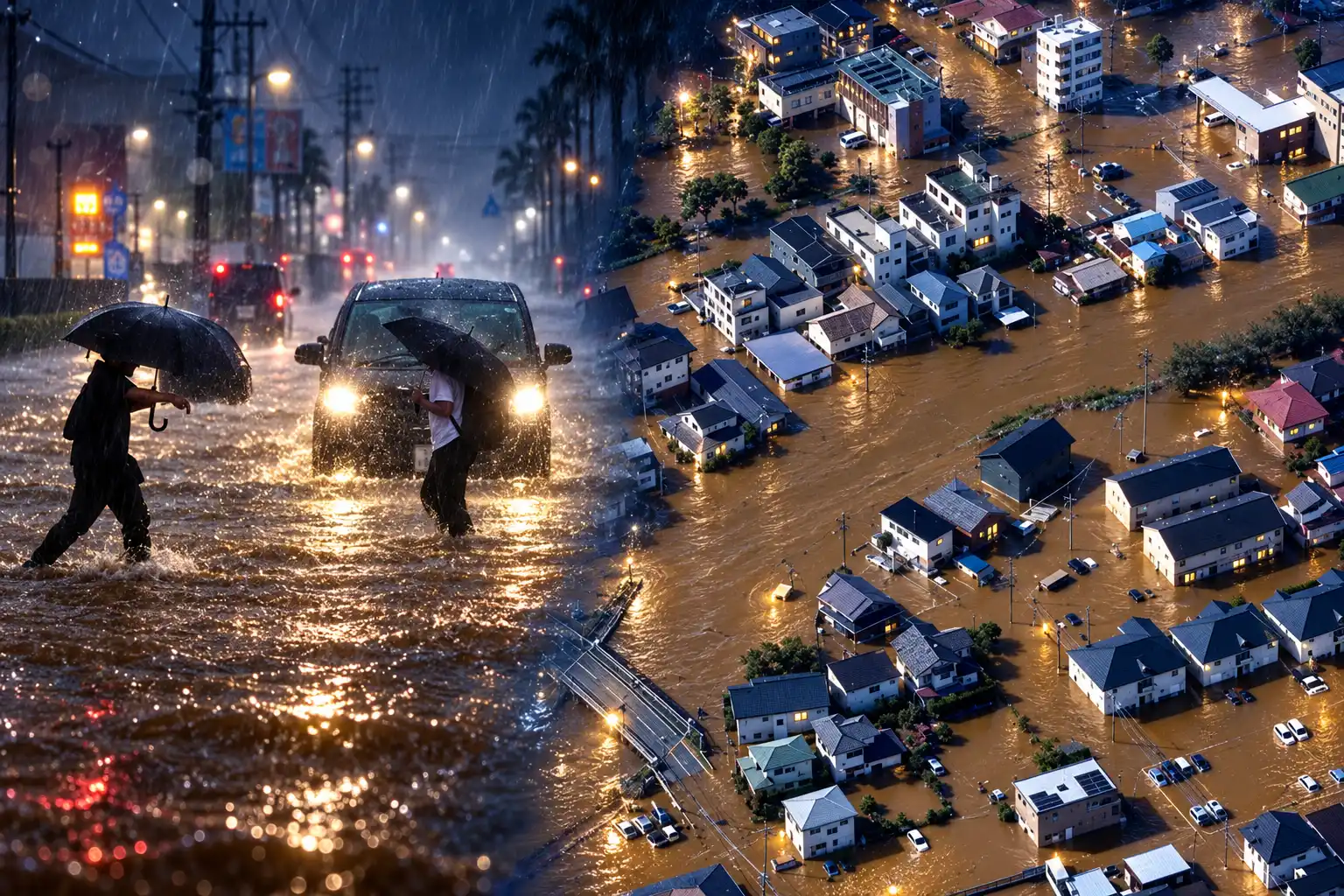
Typhoon Dujuan killed six people and left six missing after record rain set off landslides in Kanagawa and Chiba. The Japan Meteorological Agency logged 832 millimeters on Oshima in 48 hours, the highest total at that site, while the internal affairs ministry put 1,674,084 people in Ibaraki, Chiba, Tokyo, Kanagawa and Shizuoka under evacuation orders on Monday.
The year’s 25th named storm stayed offshore, then dumped a month of rain on slopes that had already failed in August. Search teams were still on those slopes after the center had moved into the Pacific.
Six Dead After Landslides in Kanagawa and Chiba
Kanagawa and Chiba prefectural officials asked for Self-Defense Forces units as police and firefighters dug through houses hit by mud. The Fire and Disaster Management Agency also listed 22 people injured. The Cabinet Office applied the Disaster Relief Act to 25 municipalities.
THE CONFIRMED DEATHS
- Yokosuka, Kanagawa: A 64-year-old woman was pulled from her home after a mudslide and was pronounced dead at the scene.
- Sodegaura, Chiba: A 51-year-old worker died after the heavy machine he was using to clear earth slid into a bamboo grove; police are investigating.
- Sanmu, Chiba: A woman in her 70s was taken to hospital after her house collapsed and was later confirmed dead.
- Kamogawa, Chiba: A couple in their 80s died when landslides struck houses in two places in the city.
- Mobara, Chiba: A woman in her 80s was confirmed dead after her home collapsed.
Yasuhiro Kaneko of the Yokosuka fire department said on Monday that the woman in that city was believed to have been buried when mud entered the house, and crews worked the scene in heavy rain. Firefighters found her around 9:30 p.m. the same day.
Six people remained unaccounted for. In Yokosuka, a couple in their 70s went missing about a kilometer from the house where the 64-year-old died. In nearby Miura, a woman in her 20s was missing after mud reached the first floor of an apartment building, and another woman was missing after a landslide damaged the building she lives in. In Kamogawa, two men, one in his 60s and one in his 70s, were unaccounted for after the slides that killed the couple in their 80s.
Oshima’s 832 Millimeters Breaks the Island Record
Oshima, about 120 kilometers south of central Tokyo, took the worst of the rain as Dujuan passed the Izu chain. In the 24 hours through 4:40 p.m. Monday, the island recorded 672.5 millimeters. The 48-hour total through 1:30 a.m. Tuesday reached 832 millimeters, more than double a typical September there, and the Japan Meteorological Agency treated it as the highest amount on record for the site.
The agency issued a highest-level landslide special warning for Oshima Town at 12:40 p.m. Monday, saying a disaster might already have occurred in designated hazard zones. The town put all 3,020 residents, in 1,901 households, under a Level 5 emergency safety notice and opened 10 shelters; 72 people were in those shelters around 1:30 p.m. Sodegaura issued a Level 5 alert for 40,000 residents, telling them to move above the second floors of their houses and stay away from slopes. Kimitsu, Ichihara, Otaki and Sanmu later went to Level 5 as well.
48-HOUR RAINFALL THROUGH EARLY TUESDAY
| Location | Rain (mm) | Period ended |
|---|---|---|
| Oshima (Izu Islands) | 832 | 1:30 a.m. Tuesday |
| Ichihara, Chiba | 487 | 2:40 a.m. Tuesday |
| Kimitsu (Sakahata), Chiba | 476.5 | 1:50 a.m. Tuesday |
| Edogawa Ward Rinkai, Tokyo | 325 | 6:10 a.m. Tuesday |
| Haneda area, Ota Ward | 261.5 | 6 a.m. Tuesday (site record) |
Kisarazu, next to Sodegaura, logged a record daily fall of 291 millimeters on Monday. Miura recorded 244 millimeters, the second-largest daily amount at that station. In Sakura, the Takasaki River overflowed and floodwater stood nearly a meter deep around JR Sakura Station on Tuesday, with trucks stranded and firefighters moving residents by rubber boat.
Warm Water Off the Izu Islands Fed the Rain
Dujuan formed east of the Marianas on September 16 and spent about five and a quarter days as a typhoon. The National Institute of Informatics Digital Typhoon archive lists a 960 hectopascal minimum pressure and a peak 10-minute wind of 75 knots. At 4 p.m. Monday the agency placed the center about 130 kilometers southeast of Katsuura, Chiba, moving northeast at 35 kph, with sustained winds of 40 meters per second (144 kph) and gusts of 55 meters per second (198 kph).
It is extremely likely that some form of disaster has already occurred in landslide-prone areas and similar zones.
Takuya Hosomi, chief forecaster, Japan Meteorological Agency
Hosomi also warned of an imminent threat to life. He said the storm had intensified more than expected after it slowed over unusually warm water near the Izu Islands. The Joint Typhoon Warning Center later tied a short burst of strengthening to warm water along the Kuroshio Current and to strong poleward outflow, before drier air, cooler water and high wind shear started to tear the system apart.
Forecasters had already described 2026 as a busy typhoon year tied to a strong El Niño. A June El Niño outlook for the typhoon season from Weathernews put above-normal risk south and southeast of Honshu from September onward, which is the corridor Dujuan used.
Chiba Was Still Recovering From August’s Floods
The same prefecture had already been through a named rain disaster this summer. On August 13 and 14, the Japan Meteorological Agency issued a Level 5 heavy-rain warning for 22 Chiba municipalities, the first time that top alert had been used there. Chiba station recorded 351 millimeters in 24 hours, a mark that beat a record dating to 1966, and 115 millimeters fell in a single hour in Chuo Ward.
Chiba’s government said on August 15 that eight people had died. Several of those deaths involved people found in floodwater or trapped in cars. The agency formally named the event the August 2026 Chiba Heavy Rain. Ichikawa, Sakura and other cities that stood in deep water then stood in it again when Dujuan arrived.
TWO RAIN DISASTERS ON THE SAME COAST
- August 13-14, 2026: Record rain hits Chiba, a Level 5 warning covers 22 municipalities, and eight deaths are confirmed by August 15.
- September 16, 2026: Dujuan is named as Typhoon No. 25 over the western Pacific.
- September 21, 2026: The storm brushes the Izu Islands and the Boso Peninsula; Level 5 landslide alerts go out for Oshima and parts of Chiba; landslides kill in Yokosuka, Sanmu, Kamogawa and Mobara.
- September 22, 2026: Authorities confirm six deaths and six missing; 832 millimeters is logged on Oshima; the Disaster Relief Act covers 25 municipalities.
On September 15, before Dujuan existed as a named storm, Prime Minister Sanae Takaichi had already listed the August 2026 Chiba heavy rains among the year’s deadly disasters and said the government would stand up a Disaster Management Agency this year as a standing command center from preparedness through recovery. The next rain did not wait for that office to open.
Silver Week Travel Collapsed Around Tokyo
The storm arrived in the middle of Silver Week, when Tokyo stations, beach towns and the two main airports are already full. All Nippon Airways cancelled 140 domestic flights, mostly at Haneda, and Japan Airlines cancelled 135, a combined 275 services that left about 42,600 passengers stranded. Some Tokaido Shinkansen runs were suspended. On Tuesday, East Japan Railway still had sections of the Sobu, Narita and Sotobo lines down from the first trains, and Keikyu halted two Miura Peninsula segments.
Tokyo Electric Power Grid said 42,260 households across four prefectures were without electricity as of 4:30 p.m. Tuesday, most of them in Chiba, with further cuts in Kanagawa, Yamanashi and Shizuoka. Damage to homes had reached more than 470 buildings in Kanagawa, Chiba and Ibaraki. The Tokyo Game Show cancelled Monday’s program and cut a day from a five-day show. Ueno Zoo and Hama-rikyu Garden closed, and Kamogawa Sea World shut for the day.
Kamakura’s tourist core flooded in the afternoon. Water covered parts of Wakamiya-oji near Tsurugaoka Hachimangu, and a car at a station-area crossing sat with water up to its headlights. Mayor Takashi Matsuo posted a photograph of a half-sunk car and told residents that driving was dangerous.
下馬の交差点や若宮大路沿いも冠水。
市内各所で冠水しておりますので、車での移動は危険です。 pic.twitter.com/ghSkDMScuY— 鎌倉市長 松尾崇 (@takashi_matsuo) September 21, 2026
The holiday packed those streets. The rain did not need a landfall in Tokyo to close them. An offshore track about 100 kilometers off Honshu was enough, once the Izu waters had loaded the clouds.
Farther west, the Asian Games in Aichi-Nagoya, which opened on September 19 and run through October 4, postponed Monday’s equestrian eventing to Tuesday. About 4,000 competitors are housed on the cruise ship Costa Serena at Nagoya Port, a floating village that organisers said they might have to move if the storm had tracked farther west.
Why Are Landslide Warnings Still in Force?
By Tuesday afternoon the agency had the center east of Japan, and most heavy-rain and landslide warnings were being lifted or cut back. The warning that remained was about water already in the ground. Landslides can start after the rain stops, the agency said, and it told Kanto residents to stay alert for slope failure, flooding in low ground, and rivers that were still high.
WHAT WE KNOW
- Deaths and missing: Six people are confirmed dead in Kanagawa and Chiba, and six remain missing, with searches under way with the Self-Defense Forces.
- Rain records: Oshima’s 832 millimeters in 48 hours is the highest total at that site, and Haneda’s 261.5 millimeters in 48 hours is a record there.
- Power and housing: 42,260 households were still dark at 4:30 p.m. Tuesday, and more than 470 buildings were damaged in three prefectures.
WHAT IS UNCONFIRMED
- The Sodegaura death: Police have not finished their inquiry into how the 51-year-old worker and his machine left the road.
- The six missing: No public confirmation has been issued on whether anyone among the Yokosuka couple, the two women in Miura, or the two men in Kamogawa has been found alive.
- Final outage and damage counts: TEPCO Grid and the fire agency were still revising household and housing tallies as crews reached flooded streets.
The cleanup death in Sodegaura is the part of the storm that continues after the wind. A man was moving earth from a road that had already failed, on ground that had been wet for days, and the slope took him with the machine.
Takaichi Left for New York After a Four-Hour Delay
Prime Minister Sanae Takaichi had been due out of Haneda at 7 p.m. Monday for her first address to the U.N. General Assembly and a meeting with U.S. President Donald Trump. The government pushed the flight to 11 p.m. so she could watch the storm a little longer. Before she left she told reporters she wanted the speech to “express Japan’s determination to exercise leadership” on energy supply chains and on technologies such as artificial intelligence.
On X she offered condolences to those killed, wrote that she had, “with a sense of urgency,” instructed Chief Cabinet Secretary Takehara and Minister Hosono to respond with utmost preparedness, and said she had boarded the aircraft. A government jet landed at John F. Kennedy International Airport later Monday night, New York time. She was due to see U.N. Secretary-General Antonio Guterres as well, and to return on Thursday.
The storm, meanwhile, was already becoming an extratropical low over cooler water east of Honshu, which is what the Joint Typhoon Warning Center had forecast once shear and dry air took hold. Sunny breaks were expected over much of Kanto on Tuesday, with high waves still possible along the Pacific coast. The people still unaccounted for were last seen in houses on those wet hills, and that is where the search stayed.

Kering’s Growing Houses Cannot Outrun a Shrinking Gucci

Studio Staff and Bitcoin Buyers Built the Eminem Leak Case

A Mutated H1N1 Strain Is Hitting Younger Immunity First

Albert Heijn Returns at One-Third as Rivals Take Share

Art Basel Paris Ends After One Public Day

Thameslink Will Pad 60,000 Ironing-Board Seats From 2027

How Tall Was Adolf Hitler Really? Debunking the Myth of his Height

Micron Sells the Memory Shortage as Five-Year Contracts

Royal Caribbean Sends Los Angeles Ships to Singapore and Brisbane

U.S. Forces Clear Hormuz Mines, Then Hit Minelayers Again
-
 NEWS2 months ago
Thameslink Will Pad 60,000 Ironing-Board Seats From 2027
-
 SCIENCE3 years ago
How Tall Was Adolf Hitler Really? Debunking the Myth of his Height
-
 NEWS2 months ago
Micron Sells the Memory Shortage as Five-Year Contracts
-
 NEWS2 months ago
Royal Caribbean Sends Los Angeles Ships to Singapore and Brisbane
-
 BUSINESS2 months ago
U.S. Forces Clear Hormuz Mines, Then Hit Minelayers Again
-

 BUSINESS2 months ago
Sweetmore Bakeries Buys Fantasy Baking for Bar Work
-

 BUSINESS2 months ago
L Catterton Installs a Kraft Heinz Operator at Kettle Cuisine
-

 NEWS2 months ago
CISA’s 100 Water System Hacks Hit One-Operator Plants