
NEWS
Apollo’s 16% Yankees Stake Tests Baseball’s Private Equity Cap
Apollo’s $2.6 billion Yankees package is 8 percent now and 8 percent later, a 16 percent slice that sits above MLB’s 15 percent private equity cap.

Apollo Sports Capital is lining up an eventual 16 percent stake in the New York Yankees as part of a $2.6 billion mix of debt and equity.
People close to the talks put Yankee Global Enterprises, the club’s parent, at more than $12 billion. The Steinbrenner family keeps a bit more than 60 percent and full control. What follows is a test of baseball’s 15 percent private equity cap, and a new price tag every other club will have to live with.
Apollo Gets 8 Percent Now and Another 8 Later
Yankee Global Enterprises announced a $2.6 billion financing agreement with affiliates of Apollo Sports Capital on August 11, 2026. The package is credit plus equity. Proceeds go to growth at the franchise and to refinancing existing debt. Apollo’s own slice of that package closed the same day. The sale of limited-partner shares was still in its final stages as of September 20.
People close to the deal say the equity is not a straight 16 percent check. Apollo pays cash for an 8 percent stake immediately and takes preferred stock for another 8 percent that can convert into ordinary equity in four years. The cash also refinances holding-company bank debt at a lower cost. Hal Steinbrenner, chairman of Yankee Global Enterprises, remains managing general partner and the club’s MLB control person. Apollo Sports Capital chief executive Al Tylis takes a newly created seat on a board that expands to 13 members.
HOW THE 16 PERCENT IS BUILT
| Piece | Size | Timing |
|---|---|---|
| Apollo common equity | 8 percent | Closed August 11, 2026 |
| Apollo preferred stock | 8 percent | Converts to equity in four years |
| Eventual Apollo stake | 16 percent | After conversion |
| Steinbrenner family | A bit more than 60 percent | Stays in control |
People familiar with the talks said the family is selling at least 4 percent of the parent company, with some limited partners selling shares of their own. One person close to the deal called the family’s cut de minimis. Official terms of the new ownership chart have not been published. People close to the talks said the parties had agreed in principle by September 20 and that a close could come that week, or slip because the structure is messy.
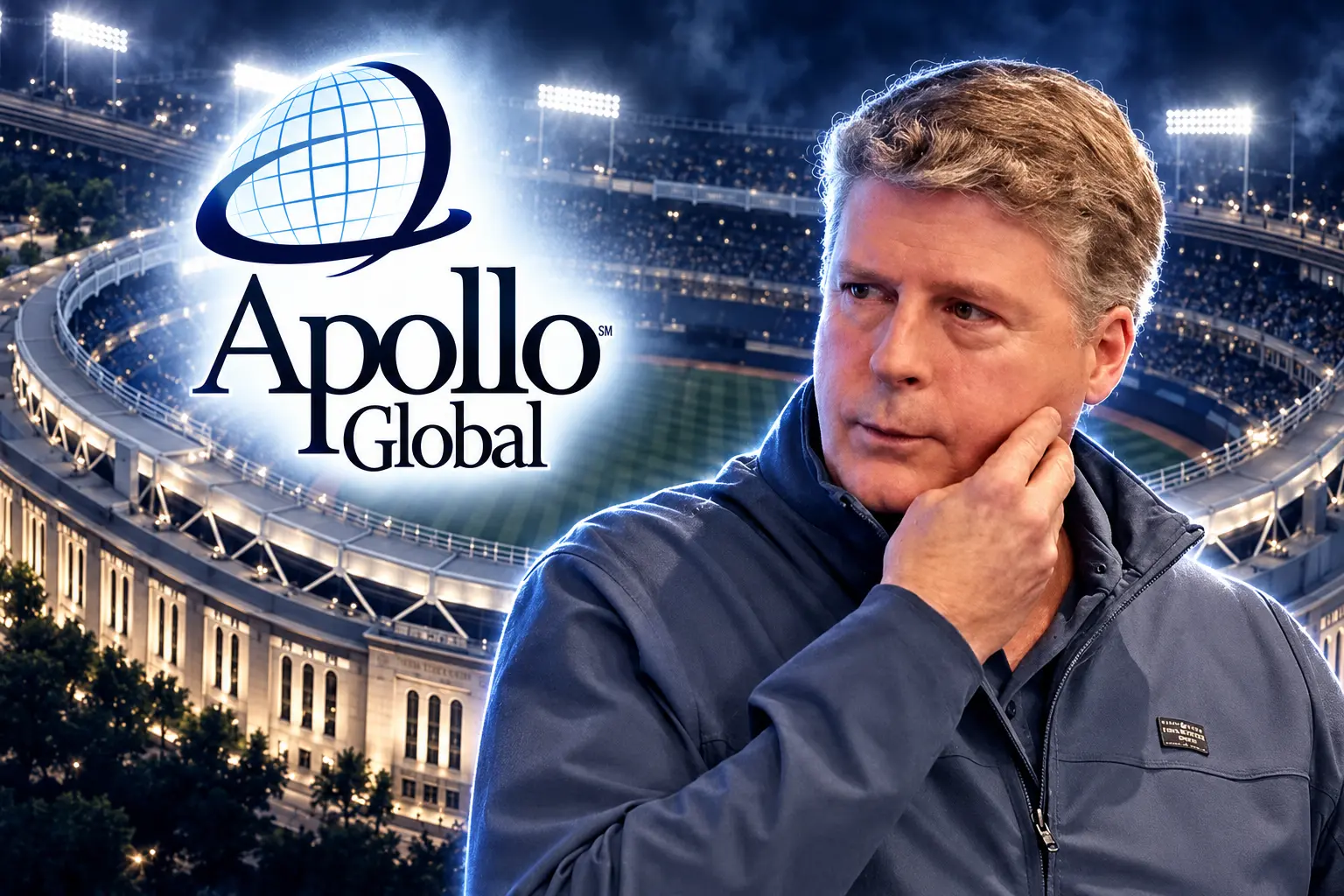
MLB’s 15% Cap Meets a 16% Yankees Stake
Major League Baseball opened the door to investment funds in 2019. Under the current rules, a single fund may hold up to 15% of a club, funds together may hold no more than 30 percent of one team, and money parked in more than one club is subject to a five-year hold. The 8 percent common slice sits inside that 15 percent box. The 16 percent economic claim does not.
People close to the talks said the league is expected to waive the cap for this structure. Baseball writer Maury Brown put the same point on X without the hedge: the Apollo deal “will be for 16% of the Yankees meaning the league is granting an exemption to PE cap.” That waiver, if it comes, is the piece other owners will study. A flagship club that needed an extra point of room has just shown that 15 percent is a starting offer.
The cap was written to keep funds from steering a club. Tylis still gets a board seat at the parent. The Steinbrenners still appoint the control person. The practical change is that the largest owner behind the family is a permanent-capital vehicle, not another set of heirs.
Limited Partners Wanted Cash, Not a Trophy
The push for the deal was duller than a $12 billion headline. People close to the talks said a group of limited partners wanted to cash out for estate planning, and Apollo wanted an anchor holding for a sports platform launched in 2025. Hal Steinbrenner led the talks for the club with Apollo chief executive Marc Rowan and with Tylis.
That is the part the pinstripe romance misses. A baseball club this valuable is an illiquid asset with a high sticker price and a thin list of buyers who can write the next check. Private equity is the exit ramp for partners who want out without forcing the family to sell control. It is also a cheaper way to refinance parent-company debt than a trip back to the banks.
We welcome Apollo to the Yankees family. We are continually seeking ways to strengthen our positioning, and this partnership allows us to explore pursuing strategic opportunities. We look forward to a successful working relationship.
Hal Steinbrenner, Chairman, Yankee Global Enterprises, August 11, 2026 release
Tylis called the Yankees “one of the most iconic franchises in sports” and thanked the family for its trust. Apollo partner Robert Givone called the package “precisely the kind of bespoke capital solution Apollo Sports Capital was built to deliver.” One major-league source, speaking as the terms leaked, said the deal “puts the Yankees on very firm footing.” A Yankees spokesman and an Apollo press representative had no immediate comment on the September details.
How an $8.8 Million Club Became a $12 Billion Parent
George Steinbrenner led a group that bought the Yankees from CBS in 1973 for $8.8 million. His children took over after his death in 2010. The family is now the longest-tenured owner in the league. The parent around the club is no longer just a baseball team. Yankee Global Enterprises holds the Yankees partnership plus stakes in Legends Hospitality, the YES Network, New York City Football Club, and AC Milan.
Sportico’s March MLB valuations ranked the Yankees first at $9.4 billion, ahead of the Los Angeles Dodgers at $9.05 billion, and 18th among sports properties worldwide. People close to the Apollo talks put the parent at more than $12 billion. Those are different rulers: one is a published team ranking from the spring, the other is what a buyer is paying into the holding company in the fall. Limited partners involved in the deal already talk as if the Yankees have lapped the Dodgers on price.
FROM CBS TO APOLLO
- 1973: George Steinbrenner’s group buys the Yankees from CBS for $8.8 million.
- 2010: Steinbrenner dies; his children take control of the club and the parent.
- 2019: MLB lets investment funds buy minority stakes, with a 15 percent cap on a single fund.
- August 11, 2026: Yankee Global Enterprises announces the $2.6 billion Apollo package; Apollo’s portion closes; Tylis joins the board.
- September 19-20, 2026: People familiar with the talks say the family is selling at least 4 percent of the parent and that Apollo’s stake will reach 16 percent after preferred stock converts.
On the field, the club clinched a third straight playoff berth in mid-September, the eighth in manager Aaron Boone’s nine seasons. It has not posted a losing record since 1992. This is not a distress sale. It is a family and a set of aging partners unlocking a price that baseball’s own rankings had not yet printed.
Eighteen Clubs Already Let Wall Street In
Once this closes, the Yankees join a PitchBook count of private equity ties across the major leagues that already puts funds in 18 of MLB’s 30 clubs. Arctos Partners has been the repeat name, with known baseball holdings that include the Dodgers, Chicago Cubs, San Francisco Giants, Houston Astros, San Diego Padres, and Boston Red Sox. RedBird Capital sits in the Red Sox through Fenway Sports Group. Sixth Street has been in the Giants. MSD Partners has been in the Miami Marlins.
The Yankees were late to that list and then jumped it on size. Most of those earlier cheques were quiet minority bits inside the 15 percent line. Apollo’s economic claim is larger, it comes with a parent-company board seat, and it needs the league to bless the extra point. If that blessing holds, every control owner sitting on a 12 or 14 percent fund stake has a new ask.
WHERE THE CAPS SIT
| League | One fund in one club | Funds in one club, combined |
|---|---|---|
| MLB | 15 percent | 30 percent |
| NBA | 20 percent | 30 percent |
| NFL | 10 percent | 10 percent |
A January 2026 Clifford Chance briefing laid out that 15 percent cap and a 30 percent club limit for baseball, with no cap on how many MLB teams one fund may hold. The NBA allows a fatter single-club slice. The NFL, which only recently let funds in, is tighter, and Apollo is not on its approved list.
The Money Covers Players, Debt, and a Work Stoppage
People close to the talks said the cash is meant to buy players, refinance expensive debt, and leave a cushion if baseball stops. That last use is the second-order one that does not show up in a valuation graphic. Owners and players are already circling a labor fight. A club that can fund a roster and a shutdown at the same time has a different winter than a club that cannot.
The competitive prompt is local. Steve Cohen’s Mets spend like a fund already. The Dodgers, with Arctos in the ownership mix, have set the player-cost ceiling. Hal Steinbrenner has spent years hearing that the Yankees talk like a big market and budget like a careful one. Apollo does not take the keys. It does make it harder to argue that the checkbook is empty.
Some of that argument is already spilling into fan talk, where the objection is not the 15 percent math. It is the record private equity has in other industries, and a wish that baseball had never let the funds in. The league crossed that line seven years ago. The Yankees are now the club making the line move.
Atlético, Wrexham, and a Board Seat in the Bronx
Apollo, which had about $1.05 trillion in assets under management as of June 30, 2026, launched Apollo Sports Capital in 2025 as a permanent-capital platform. Sportico has described that sports vehicle at roughly $6 billion. The Yankees stake is its largest holding. The rest of the book is already global, and it is built more on credit and hybrid paper than on pure team equity.
WHAT APOLLO SPORTS CAPITAL ALREADY HOLDS
- Atlético de Madrid: Apollo became majority shareholder of Atlético de Madrid on March 12, 2026, a deal Sportico put at a $2.55 billion valuation, with club bosses staying in place.
- Wrexham: A minority stake in the Welsh club backed by Ryan Reynolds and Rob Mac.
- Tennis: Investments in the Madrid and Miami Open tournaments.
- Yankees parent: 8 percent common equity now, 8 percent preferred converting later, plus Tylis on the Yankee Global Enterprises board.
The firm said the Spanish club is a flagship majority bet and is not part of a multi-club control web. On September 10, 2026, Tylis said Apollo is “interested in any great sports property anywhere in the world, which clearly includes the NFL.” The football league’s private equity window is still 10 percent a club and six clubs a fund. Apollo has spent its way into baseball and LaLiga first.
Few franchises have shaped the history of sports like the New York Yankees.
Apollo Sports Capital has become a strategic investment partner to Yankee Global Enterprises, providing a bespoke capital solution to support the continued growth of the Yankees franchise. Learn more:… pic.twitter.com/B1Ebeb8zaT— Apollo Global Management (@apolloglobal) August 11, 2026
Gibson Dunn advised Yankee Global Enterprises, with Goldman Sachs as strategic advisor. Paul, Weiss, Rifkind, Wharton & Garrison led for Apollo Sports Capital, with Katten Muchin Rosenman on the regulatory work. Those names are the tell that MLB’s ownership file, not just a loan agreement, is in play.
The family that has held the Yankees since 1973 still holds the club. Apollo still has to finish buying the limited partners out, and the league still has to say yes to 16 percent. If both of those land, the number other owners will remember is not $2.6 billion. It is the extra point above 15, and the price north of $12 billion that came with it.

Kering’s Growing Houses Cannot Outrun a Shrinking Gucci

Studio Staff and Bitcoin Buyers Built the Eminem Leak Case

A Mutated H1N1 Strain Is Hitting Younger Immunity First

Albert Heijn Returns at One-Third as Rivals Take Share

Art Basel Paris Ends After One Public Day

Thameslink Will Pad 60,000 Ironing-Board Seats From 2027

How Tall Was Adolf Hitler Really? Debunking the Myth of his Height

Micron Sells the Memory Shortage as Five-Year Contracts

Royal Caribbean Sends Los Angeles Ships to Singapore and Brisbane

U.S. Forces Clear Hormuz Mines, Then Hit Minelayers Again
-
 NEWS2 months ago
Thameslink Will Pad 60,000 Ironing-Board Seats From 2027
-
 SCIENCE3 years ago
How Tall Was Adolf Hitler Really? Debunking the Myth of his Height
-
 NEWS2 months ago
Micron Sells the Memory Shortage as Five-Year Contracts
-
 NEWS2 months ago
Royal Caribbean Sends Los Angeles Ships to Singapore and Brisbane
-
 BUSINESS2 months ago
U.S. Forces Clear Hormuz Mines, Then Hit Minelayers Again
-

 BUSINESS2 months ago
Sweetmore Bakeries Buys Fantasy Baking for Bar Work
-

 BUSINESS2 months ago
L Catterton Installs a Kraft Heinz Operator at Kettle Cuisine
-

 NEWS2 months ago
CISA’s 100 Water System Hacks Hit One-Operator Plants